

A round-up of news from the waste and resources industry, including TerraCycle, Asda, PepsiCo and GoodWe.
Jump to:
TerraCycle Foundation clears 581 tonnes of waste from Bangkok waterways
Asda's ‘price proposition’ will see refill products cheaper than packaged alternatives
PepsiCo aims for 20 per cent of its beverages to come in reusable packaging by 2030
GoodWe launches solar EV charger to accelerate energy independence for homeowners
TerraCycle Foundation clears 581 tonnes of waste from Bangkok waterways
The TerraCycle Global Foundation, a non-profit founded by TerraCycle, has cleared 581 tonnes of waste from waterways in its first two years – none of which is sent to landfill.
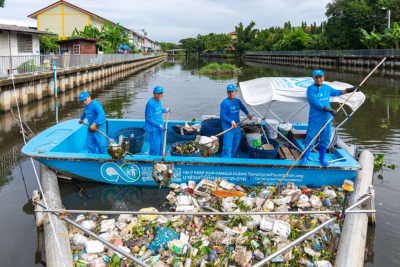
Since June 2020 the Foundation has operated in canals throughout Bangkok, partnering with local community and government organisations with the aim of stopping waste from reaching the ocean.
Some 80 per cent of the plastic waste in the ocean, where waste breaks down into microplastics and becomes harder to capture and recycle, is transported via rivers or coastlines, TerraCycle says.
To collect waste, including plastic, the Foundation is using three ‘wildlife-safe’ traps in canals – each trap collects 150,000 -175,000 pounds of waste from the water per year.
Tom Szaky, Founder of TerraCycle, says: “In its relatively short lifespan, the TerraCycle Global Foundation has already had a significant impact on the health of our planet.
“Not only has the Foundation made waterways cleaner and safer places for wildlife, but we have seen real benefits to the local communities as well.
“We’re proud of our team members for their dedication to driving our mission forward and showing how crucial collecting waste before it has reached the ocean really is.”
Asda's ‘price proposition’ will see refill products cheaper than packaged alternatives
As part of its new refill proposition, Asda has announced a ‘refill price promise’ which guarantees that each refill product will be cheaper than packaged alternatives. It is hoped that this development to the refill scheme will increase customer participation.
Since introducing refill two years ago, the supermarket has partnered with WRAP and Unilever, with funding from Innovate UK, to find out customer barriers to participation.
Consumers highlighted pricing as a barrier, leading to Asda’s implementation of the refill price strategy. The requirement to combat uncertainty and apprehension concerning refill also arose, leading to the supermarkets' move to make the experience ‘fun and enjoyable’ – improving customer communication and focusing on four key categories (cereals, pet food, store cupboard, and rice, pasta and pulses).
Shoppers will also be able to bring their own containers or buy a reusable container or bag in-store. The feedback that carrying back multiple containers is ‘too bulky and hard’ has led Asda to offer a new, 10p reusable bag.
Susan Thomas, Asda's Senior Director of Sustainable commercial activity, commented: “We know the cost of living crisis is having a big effect on our customers, so it is important we recognise this in the refill space through our ‘refill price promise’ and ensure customers are getting an even better deal. As well as being cheaper, refill allows customers to buy the exact amount they need, helping them stick to budgets, while at the same time reducing food waste at home.”
PepsiCo aims for 20 per cent of its beverages to come in reusable packaging by 2030
PepsiCo has presented a new global packaging goal which intends to ensure that 20 per cent of its drinks come in reusable packaging by 2030, doubling its current figures.
In line with the Ellen MacArthur Foundation's ‘Reuse – Rethinking Packaging’ framework, PepsiCo says it will adopt four approaches to achieve the goal, including expanding its SodaStream business, building out its refillable plastic (PET) and glass bottle offerings, increasing its fountain drinks business with reusable cups and accelerating growth in powders and concentrates. I t claims that the reusable containers offered within its SodaStream business could eliminate the use of 200 billion plastic bottles by 2030.
The company has previously announced its goal to reduce virgin plastic per serving by 50 per cent by 2030 and to become Net Zero by 2040.
Jim Andrew, Chief Sustainability Officer, PepsiCo, said: "Fundamentally transforming the traditional beverage consumption model will require making reusable and refillable options accessible and convenient, at scale, for consumers – and that's what PepsiCo aims to do.
"PepsiCo will accelerate our investment in disruptive innovation and advocate for policies that allow us to scale up reusable packaging options, platforms and programs so that we can offer consumers a wide variety of alternative ways to enjoy their favourite beverages while moving away from reliance on single-use packaging."
GoodWe launches solar EV charger to accelerate energy independence for homeowners
GoodWe, a manufacturer of solar inverters, is launching a new solar-powered electric vehicle (EV) battery charger with the aim of helping UK homeowners extend their energy independence from the grid.
According to the manufacturer, the charger is designed to maximise the self-consumption of electricity by providing a cost-efficient generating and charging solution compatible with all EV types.
The GoodWe EV charger is a three-phase AC charger available in 7kW, 11 kW and 22 kW versions capable of delivering 7,000 watts, 11,000 watts and 22,000 watts of power. The unit is fully protected, including overvoltage and under voltage protection, AC surge and overload protection.
As it will use ‘smart charging management’, the inverter should be able to prioritise charging the EV’s battery to ensure the vehicle is charged quickly and easily.
The Committee on Climate Change has predicted EV usage to increase from the current 400,000 vehicles to 23.2 million by 2032, and by 2050 up to 49.0 million.
Eugene Lucarelli, strategic marketing manager at GoodWe UK, said: “The projected growth rate for electric vehicles, combined with rising energy prices mean that it is only going to become more and more important for homeowners to be able to generate and store their own electricity for use around the home and with their vehicles.”
“Most solar PV systems can generate more electricity than a domestic household needs at the current time and the feed-in tariff is now so low there is little benefit in selling surplus electricity back to the grid. Therefore, it is more important than ever that households generate and consume all their own electricity and EV charging can play a key role in maximising the benefit of solar PV.”


Get our weekly digest
resource.co article ai

How will the government and DMOs address the challenges of including glass in DRS while ensuring a level playing field across the UK?
There's no easy solution to include glass in the DRS while maintaining a level playing field. Potential approaches include a phased introduction of glass, potentially with higher deposits to reflect its logistical challenges. The government and DMOs could incentivise innovation in glass packaging design and subsidise dedicated return points for glass-handling. Exemptions for smaller businesses unable to handle glass might also be necessary. Any successful solution will likely blend several approaches. It must address the differing priorities of devolved administrations, balance environmental benefits with logistical and cost implications, and be supported by robust consumer education campaigns emphasizing the importance of glass recycling.