

Material specification sets out barcode, labelling and container standards that drinks producers must meet 18 months before the deposit return scheme goes live.
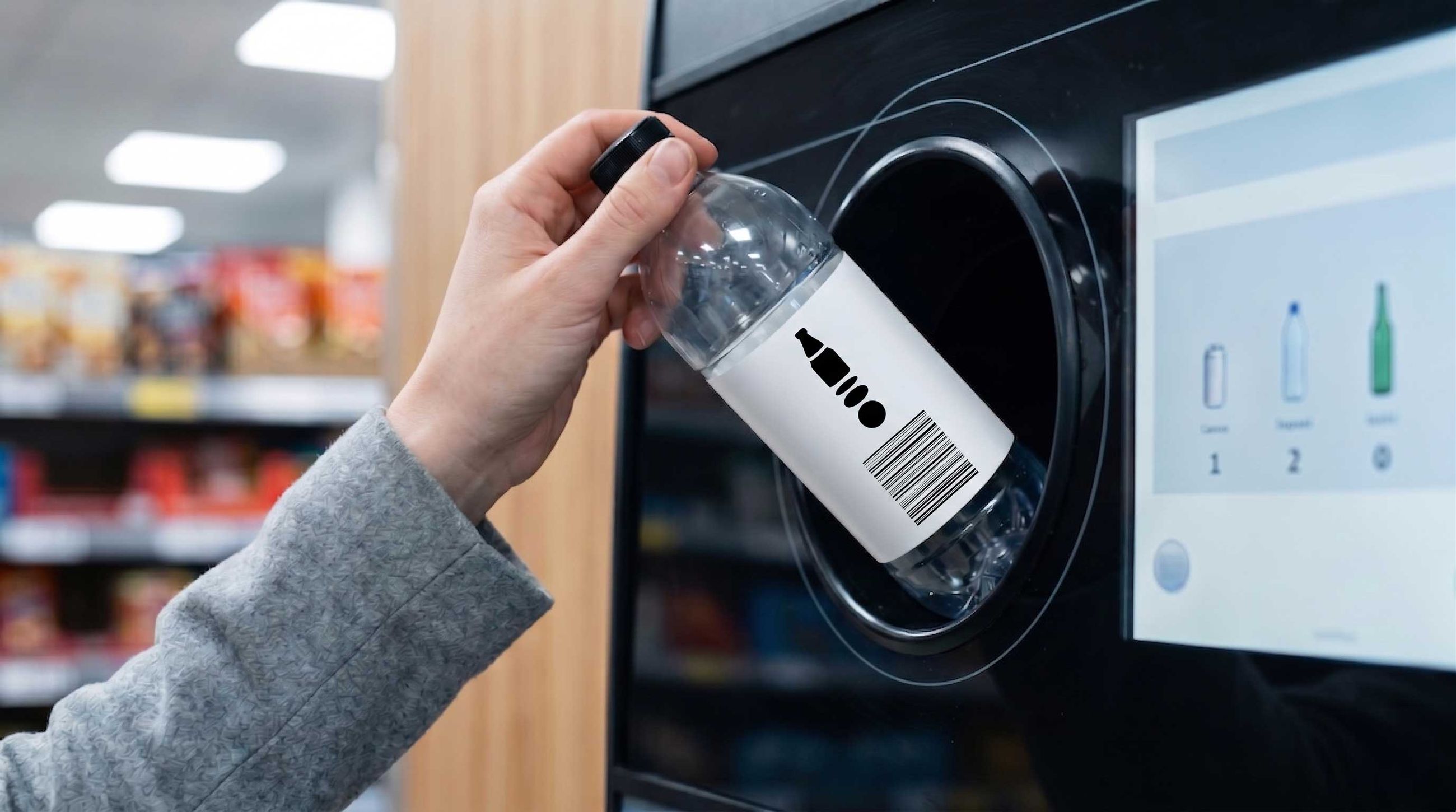
Drinks producers will need to replace their existing product barcodes with new DRS-specific codes before the UK deposit return scheme launches in October 2027, according to a material specification published by Exchange for Change, the not-for-profit organisation appointed to run the scheme across England, Scotland and Northern Ireland.
The specification covers all PET, aluminium and steel containers between 150ml and three litres. It requires each product to carry a dedicated barcode registered on Exchange for Change's Article List, a centrally maintained database that will be updated daily and distributed to every reverse vending machine (RVM) via an API. Existing product barcodes will not be valid under the scheme.
Producers must register all in-scope products by 9 July 2027, 12 weeks before the scheme goes live. Exchange for Change says the lead time is needed to process the tens of thousands of stock keeping units that will need to be added to the system. Late registrations submitted after that date will be handled on a best-efforts basis but are not guaranteed.
The barcode requirement has practical implications for packaging artwork. Barcodes must be placed in vertical ladder format on the container's main label, at least 8mm from the bottom of cans, and never on the top or bottom of any container. They must be readable at up to 30 degrees of tilt and meet ISO 15420 quality standards. RVMs will also need to read 2D data matrices and QR codes from launch, though Exchange for Change says further guidance on these formats will follow.
Beyond barcodes, the specification sets out dimensional limits for RVM acceptance. Containers must be between 50mm and 125mm in diameter and between 75mm and 360mm in height. Cylindrical shapes are preferred, with non-cylindrical or top-heavy containers subject to additional testing. PET bottles must be compactable by at least 55 per cent and aluminium or steel cans by at least 75 per cent.
Labelling and divergence
For PET bottles, Exchange for Change recommends label and sleeve coverage of less than 50 per cent of the container's surface area. While RVMs can accept higher coverage, the organisation says reduced labelling improves the quality of recycled material. Aluminium and steel cans are not subject to this guidance.
The DRS deposit logo, which must appear on all in-scope products, has not yet been finalised. Exchange for Change says logo specifications will be published in the second quarter of 2026, with an approval process for self-adhesive labels to follow.
Due to the Windsor Framework, Northern Ireland is required to implement the EU Single Use Plastics Directive's tethered cap requirement for PET bottles and other single-use plastic drinks containers up to three litres. Legislation is pending, but the specification tells producers to prepare for the requirement.
The document also confirms a low-volume product exemption. Producers manufacturing or importing 6,250 units or fewer per SKU in the scheme's first year, falling to 5,000 from 2028, will be exempt from producer fees and labelling requirements, though they must still register with Exchange for Change.
Some elements of the specification remain unfinished. Exchange for Change says further guidance on several processes will be shared by the end of July 2026, and product testing guidelines for standard container shapes will follow by September 2026. The organisation added a caveat that the specification "does not limit or redefine regulated scheme articles" and that the governing regulator in each nation has final authority over what is in scope.


Get our weekly digest
resource.co article ai

How will the government and DMOs address the challenges of including glass in DRS while ensuring a level playing field across the UK?
There's no easy solution to include glass in the DRS while maintaining a level playing field. Potential approaches include a phased introduction of glass, potentially with higher deposits to reflect its logistical challenges. The government and DMOs could incentivise innovation in glass packaging design and subsidise dedicated return points for glass-handling. Exemptions for smaller businesses unable to handle glass might also be necessary. Any successful solution will likely blend several approaches. It must address the differing priorities of devolved administrations, balance environmental benefits with logistical and cost implications, and be supported by robust consumer education campaigns emphasizing the importance of glass recycling.