

Beauparc launches recycling initiative to combat use of virgin material in wheelie bins
Waste management company Beauparc has launched a new circular initiative – taking waste post-consumer plastic from collected sources, combining it with shredded plastic from broken wheelie bins and blending it to create ‘brand-coloured, new wheeled bins’.
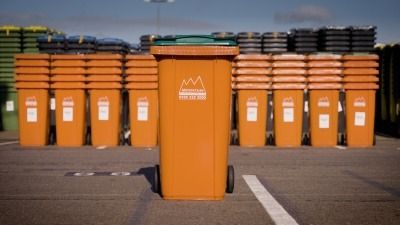
Initially, the project was developed by one of Beauparc’s UK businesses, Mountain Recycling, and led by its director Abigail Johnson to prevent the need to use virgin material to produce their ‘orange’ branded wheeled bins.
The initiative has come as a result of Beauparc’s investment to better separate post-consumer plastic, which has enabled the delivery of re-processed, recycled materials. This change has permitted modifications to the original manufacturing process, where virgin material and additional pigment was required to add colour and stability to the blend.
Johnson commented: “Until now we have had to use 100 per cent virgin material to produce our orange-coloured branded bins. That for me has been a real conflict, not only for the group’s sustainability values but for me personally.
“With this initiative, we’re absolutely leading the way with resource recovery and recycling. The technologies we have in place at our processing facilities are advanced and multi-layered which means that we are really pushing the boundaries of recycling capabilities and what we contribute towards the circular economy.”
Record funding uplift for UK battery research and development
Last week (21 October), Jacob Rees-Mogg confirmed that the UK's ‘world-leading manufacturing industries’ will be supported by £211 million in new government funding for battery research and innovation.
The funding will be delivered between 2022 and 2025 by UK Research and Innovation (UKRI) with support from the Faraday Institution, Innovate UK and the UK Battery Industrialisation Centre (UKBIC).
As then Business Secretary, before Grant Shapps was appointed to the role on 25 October, Rees-Mogg highlighted that funding will be delivered through the Faraday Battery Challenge, which first began in 2017 and aims to support scientific technology development and manufacturing scale-up capability for batteries in the UK.
The Faraday Battery Challenge says it will combine:
- Research and capability development to reduce battery weight and cost, increase energy and power, and ensure reliability and recyclability;
- Collaborative business-led innovation in the UK battery sector, development of the wider network and skills needed to manufacture batteries through Innovate UK; and
- Manufacturing scale-up & skills development at the UKBIC the national battery manufacturing development facility.
Funding is expected to produce opportunities for private investment and ‘economic growth’ in industries where fast charging batteries will be essential – for example, domestic energy storage and electric vehicles.
Financial Conduct Authority presents new rules to tackle greenwashing
With the aim of tackling greenwashing, the Financial Conduct Authority (FCA) is proposing various new measures including investment product sustainability labels and restrictions on how terms like ‘ESG’ (Environmental, Social and Governance), ‘green’ or ‘sustainable’ can be used.
Its objective is to protect consumers and ‘improve trust in sustainable investment products’. FCA highlights that this development will become part of its commitment made in the ESG Strategy and Business Plan, to build trust and integrity in ESG-labelled instruments, products and the supporting ecosystem.
According to the authority, the number of investment products marketed as ‘green’ or making wider sustainability claims has increased – these exaggerated, misleading or unsubstantiated claims about ESG credentials can damage confidence in the products.
As a result, the FCA says it wants to ensure that consumers and firms can trust that products have the sustainability characteristics they claim to have.
Sacha Sadan, the FCA’s Director of Environment Social and Governance, said: “Greenwashing misleads consumers and erodes trust in all ESG products. Consumers must be confident when products claim to be sustainable that they actually are. Our proposed rules will help consumers and firms build trust in this sector.
“This supports investment in solutions to some of the world’s biggest ESG challenges. This places the UK at the forefront of sustainable investment internationally. We are raising the bar by setting robust regulatory standards to protect consumers in line with our wider FCA strategy.”
DS Smith announces new Managing Directors for Recycling and Paper in Europe
Sustainable packaging business DS Smith has announced the appointment of Michael Orye as new Managing Director of its Recycling division in Europe, and Rogier Gerritsen as Managing Director of its Paper division in Europe.
According to DS Smith, Orye has ‘extensive experience’ from the packaging industry and a history of promoting a circular way of working – he will be joining DS Smith from the food packaging business Faerch AS, where he served as the CEO for Central Europe and Recycling.
Orye has also held senior roles in other companies in the sector, including Huhtamaki, where he worked as Executive Vice President, and Amcor, where he played a ‘significant role’ in growing the business across multiple markets in the United States and Europe.
Rogier Gerritsen, who previously held the recycling role that Orye will take on, will begin his new role as Managing Director of Paper in Europe. Gerritsen joined DS Smith in 2012 when the company acquired SCA Packaging and has since held senior roles in both the Paper and Recycling divisions, including most recently Managing Director for Recycling Europe.
DS Smith says that Gerritsen has ‘acquired a wealth of knowledge and experience across the full spectrum of sustainable paper and packaging production’.He will be responsible for the company’s 13 paper mills in Europe.
Orye and Gerritsen will both report to Niels Flierman, MD Paper, Recycling and Capex.
Michael Orye commented: “As Europe’s leading paper and cardboard recycler with a circular business model, DS Smith is in a unique position to shape the industry and lead the transition to the circular economy.
“It is a very exciting time to join the company, and I look forward to continuing to help our customers achieve their sustainability targets.”
Rogier Gerritsen added: “It is vital for our paper and recycling operations to work hand in hand, and I’m looking forward to rejoining the Paper division to support our portfolio of paper mills in Europe at a time when the demand for sustainable, fibre-based packaging solutions is rapidly growing.”
Beverage Cartons Alliance announces new Design for Recycling guidelines
The Alliance for Beverage Cartons and the Environment (ACE) has today (26 October) published new Design for Recycling (DfR) guidelines to provide beverage carton makers with technical advice on materials and existing recycling processes.
This forms a part of ACE’s 2030 Roadmap which hopes to deliver ‘the most sustainable packaging’ for food supply systems – systems which are renewable, climate positive and circular.
The guidelines are based on consultations with stakeholders including recyclers, waste management operators, and technology providers.
ACE is a European platform for beverage carton manufacturers and paperboard suppliers for the circularity, sustainability and safety of packaging. Member companies include Tetra Pak, Elopak and SIG Combibloc.
Annick Carpentier, Director General of ACE, said: “Beverage cartons are recycled throughout the EU.
“By providing guidelines on the material composition of beverage cartons and how they should be designed for recycling, the industry continues to show its commitment to increasing the recyclability of beverage cartons.
“The Design for Recycling Guidelines are a sound basis to define the recyclability of packaging.”


Get our weekly digest
resource.co article ai

How will the government and DMOs address the challenges of including glass in DRS while ensuring a level playing field across the UK?
There's no easy solution to include glass in the DRS while maintaining a level playing field. Potential approaches include a phased introduction of glass, potentially with higher deposits to reflect its logistical challenges. The government and DMOs could incentivise innovation in glass packaging design and subsidise dedicated return points for glass-handling. Exemptions for smaller businesses unable to handle glass might also be necessary. Any successful solution will likely blend several approaches. It must address the differing priorities of devolved administrations, balance environmental benefits with logistical and cost implications, and be supported by robust consumer education campaigns emphasizing the importance of glass recycling.