

Zero Waste Europe has published proposals for the EU Circular Economy Act that would split EPR fees into waste management and waste reduction budgets, alongside a temporary fund to finance reuse and repair systems until 2030.
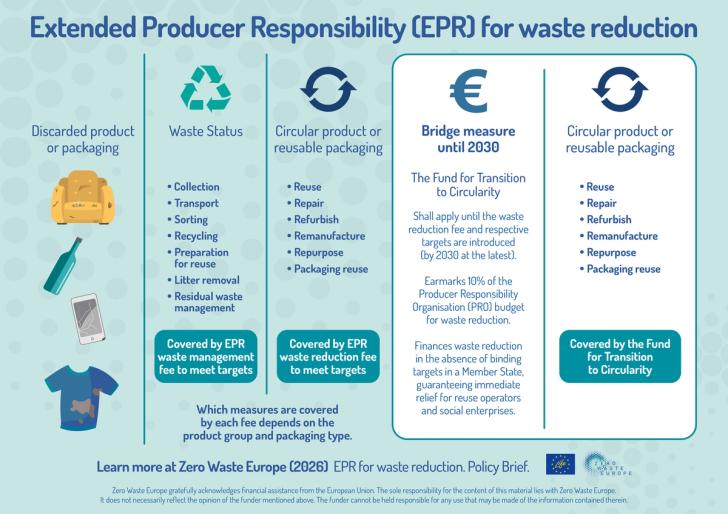
Environmental network Zero Waste Europe (ZWE) has proposed splitting Extended Producer Responsibility (EPR) fees into two separate budgets - one for waste management and another for waste reduction - as part of measures it wants included in the upcoming EU Circular Economy Act.
The proposals, set out in a policy brief published this month, respond to the EU's stagnating circularity rate. Eurostat data published in November 2024 showed the bloc's circular material use rate at 12.2 per cent, having increased by just 1.5 percentage points since 2010. The EU's target, established under the 8th Environmental Action Programme, is to reach 22.4 per cent by 2030.
EPR schemes already operate across several product categories in the EU, including packaging, electronics and batteries, with fees levied on producers to cover end-of-life waste management costs. ZWE wants these existing budgets split in two: a waste management fee that continues to fund collection, sorting and recycling, and a new waste reduction fee directed at repair, reuse and refurbishment.
"The waste reduction fee should cover, for example, the budget necessary to achieve waste reduction targets, via reuse, repair, refurbishment and similar measures," said Theresa Mörsen, Waste & Resources Policy Manager at ZWE.
A bridge measure until 2030
Pinning down what a waste reduction fee should look like is not straightforward, however, given patchy data on the costs of reduction and reuse systems across Member States. As a workaround, ZWE proposes a temporary "fund for the transition to circularity" that would earmark a minimum percentage of Producer Responsibility Organisation (PRO) budgets for reduction and reuse activities.
This interim fund would run until 2030, giving Member States time to gather the cost data needed to set dedicated waste reduction fees.
ZWE also wants legally binding targets for PROs, along with stronger governance and transparent reporting, to make sure the money actually reaches circular business models.
"Most of the initiatives to boost reuse and repair today, be it repair vouchers or local reusable packaging systems, are financed by the public budget. As treasuries are increasingly under pressure, producers must, in line with the Polluter Pays Principle, bear a greater share of the costs of the transition to circularity," Mörsen added. "The general mindset is still pretty much stuck with protecting outdated linear business models instead of helping new ones to thrive."
Circular Economy Act expected in 2026
The European Commission is expected to table the Circular Economy Act in the second half of 2026 as part of its Clean Industrial Deal. The Act is intended to create a single market for secondary raw materials, streamline EPR schemes and set end-of-waste criteria across the bloc.
A European Environment Agency assessment from 2024 found the continent "far from meeting circularity targets" and called for a shift beyond waste management towards reducing resource extraction, designing products for circularity and investing more in repair and reuse.
ZWE has previously called for the Circular Economy Act to introduce economy-wide measures to internalise the environmental costs of resource consumption, including expanded carbon pricing and quality-focused recycling standards.
To reach 22.4 per cent by 2030, the EU would need to add more than 1.7 percentage points to its circularity rate each year - more than it managed in the entire 14 years between 2010 and 2024.
//standfirst//
Zero Waste Europe has published proposals for the EU Circular Economy Act that would split EPR fees into waste management and waste reduction budgets, alongside a temporary fund to finance reuse and repair systems until 2030.


Get our weekly digest
resource.co article ai

How will the government and DMOs address the challenges of including glass in DRS while ensuring a level playing field across the UK?
There's no easy solution to include glass in the DRS while maintaining a level playing field. Potential approaches include a phased introduction of glass, potentially with higher deposits to reflect its logistical challenges. The government and DMOs could incentivise innovation in glass packaging design and subsidise dedicated return points for glass-handling. Exemptions for smaller businesses unable to handle glass might also be necessary. Any successful solution will likely blend several approaches. It must address the differing priorities of devolved administrations, balance environmental benefits with logistical and cost implications, and be supported by robust consumer education campaigns emphasizing the importance of glass recycling.