

1 April - A fleet of autonomous robots is patrolling the streets of Nantwich in what engineers at the University of Manchester's Centre for Robotics and AI describe as the UK's first live trial of AI-driven litter collection.
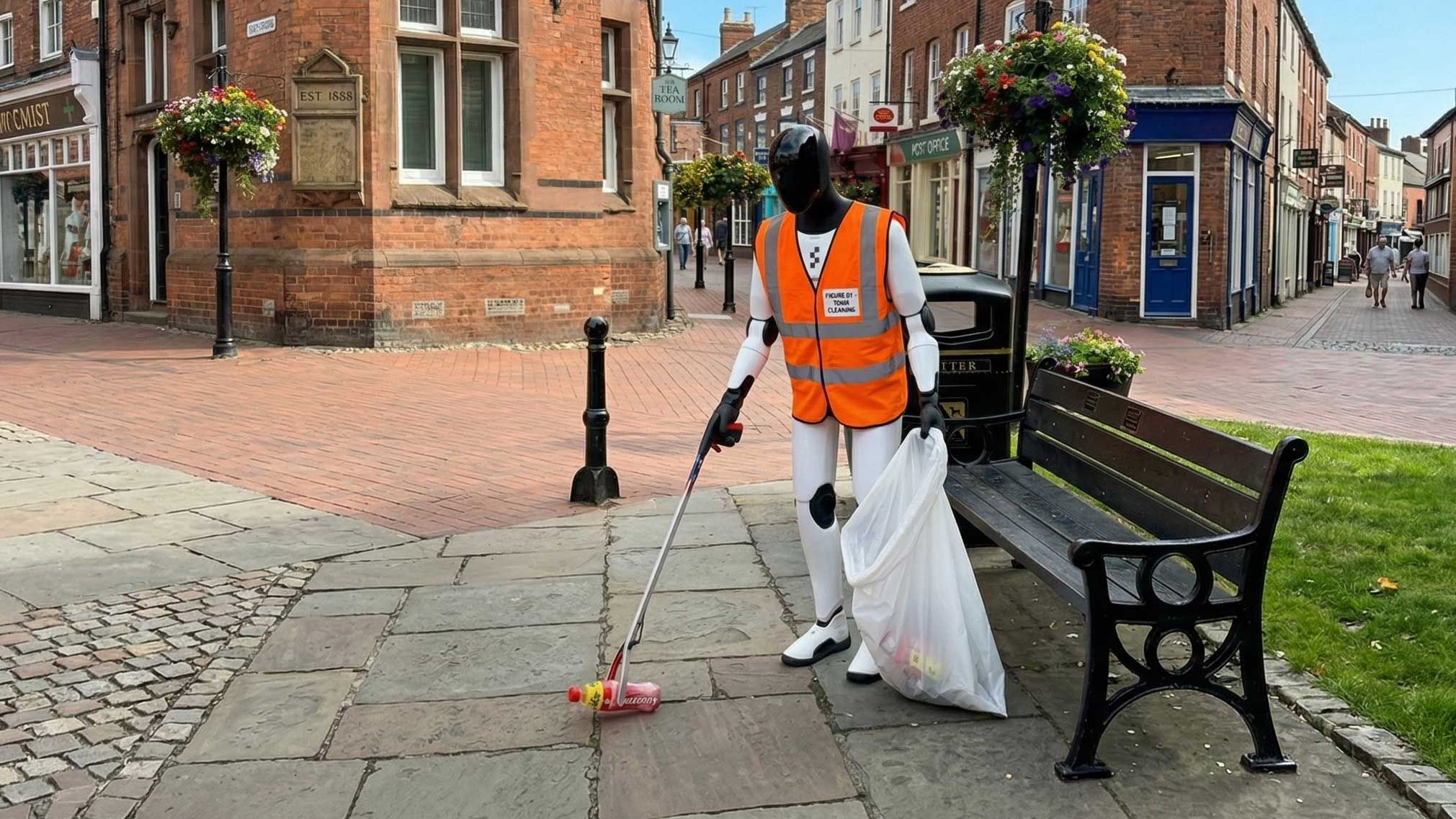
Engineers from the University of Manchester's Centre for Robotics and AI have deployed a fleet of 12 autonomous litter collection robots across Nantwich town centre, in what is believed to be the first trial of its kind in the UK.
The six-month pilot, funded through a £2.4 million Innovate UK grant, uses humanoid robots supplied by California-based Figure AI, fitted with high-visibility vests and equipped with standard litter pickers and bin bags. The machines walk upright on two legs through pedestrian areas, using onboard cameras and AI vision systems to identify discarded litter before picking it up and bagging it in much the same way a human operative would. Each unit returns to a central charging hub on Beam Street once its bag is full or its battery runs low.
Professor Al Gorithm, who leads the project at the University of Manchester's Centre for Robotics and AI, said the trial was focused on gathering reliable performance data. "We are averaging 47 pieces of litter collected per robot per hour across the fleet, which is broadly in line with our lab simulations," he said. "The limiting factor at present is battery life. Each unit runs for approximately 90 minutes between charges, so we are looking at a 40-minute turnaround before redeployment."
His colleague Dr Ann Droid, who designed the robots' object recognition system, added that the machines could distinguish between litter and fixed street furniture with 94 per cent accuracy. "The main challenge has been cigarette butts, which the litter picker struggles with below a certain size threshold," she said. "We have also had a few incidents where a unit has attempted to bag a pigeon, but the avian false-positive rate is now below 2 per cent."
Residents have largely responded positively, though one local shopkeeper told Resource that an early-morning unit had "given her the fright of her life" when it walked past her window at 6am. "I thought it was a spaceman," she said. "Then it picked up a Greggs wrapper and carried on up the high street."
Cllr Hugh Jego, Leader of Nantwich Town Council, has been less restrained in his assessment. "Nantwich has always been ahead of the curve - we had a Waitrose before most of Cheshire - and it is only fitting that we are the first town in the country to deploy this kind of technology," he said. "I have already written to the Prime Minister to suggest that Nantwich be designated a National Centre of Excellence for Robotic Street Management."
Joe Kwonsu, spokesperson for the Department for Environment, Food and Rural Affairs (Defra), said the department was monitoring the Nantwich trial closely. "In light of the ongoing bin strike in Birmingham, which has now entered its second year, there is clearly a role for exploring the potential of a non-unionised workforce," he said. "These units do not require tea breaks, do not submit grievance procedures, and have yet to ballot for industrial action."
Kwonsu added that the cost per piece of litter collected currently worked out at approximately £4.73 per item. "That compares very favourably with the average cost of a littering prosecution, which is currently around £860," he said.
Mayor Raymond Gunn, who chairs Nantwich Town Council's ceremonial functions, has taken a more expansive view of the robots' potential. "Picking up litter is all well and good, but what I really want to see is these machines issuing ASBOs to the little sh*ts dropping it in the first place," he said. "I have been in discussions with the chief constable about whether we might arm them with tasers. Nothing lethal, obviously - just a gentle reminder to put your crisp packet in the bin."
Cheshire Police confirmed it had received correspondence from Mayor Gunn's office but said it had no plans to deputise autonomous robots at this time.
Professor Gorithm struck a more measured tone. "Our focus remains firmly on collection efficiency and operational uptime," he said. "The enforcement question is well beyond our remit. We are robotics engineers, not legislators. If we can get the battery cycle down to a 25-minute turnaround and push collection rates above 60 items per hour, that would be a meaningful outcome for this trial."






Get our weekly digest
resource.co article ai

How will the government and DMOs address the challenges of including glass in DRS while ensuring a level playing field across the UK?
There's no easy solution to include glass in the DRS while maintaining a level playing field. Potential approaches include a phased introduction of glass, potentially with higher deposits to reflect its logistical challenges. The government and DMOs could incentivise innovation in glass packaging design and subsidise dedicated return points for glass-handling. Exemptions for smaller businesses unable to handle glass might also be necessary. Any successful solution will likely blend several approaches. It must address the differing priorities of devolved administrations, balance environmental benefits with logistical and cost implications, and be supported by robust consumer education campaigns emphasizing the importance of glass recycling.