

WRAP site provides tailored guidance, downloadable assets, and a waste calculator for different sectors to help meet new regulations.
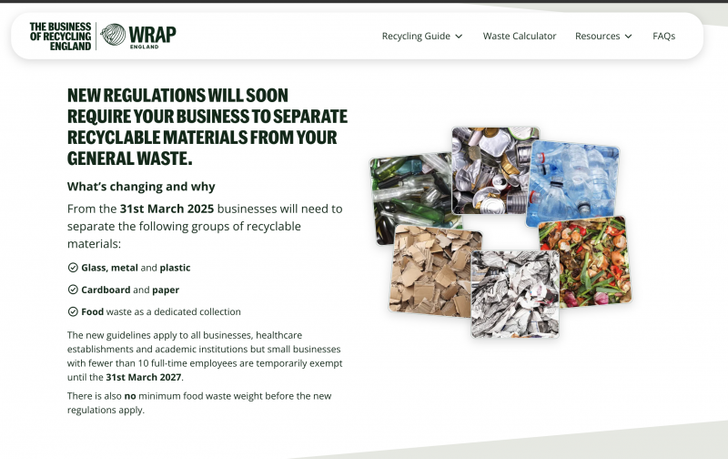
With Simpler Recycling legislation set to take effect on 31 March 2025, businesses across England will soon be required to change their waste management systems to separate key recyclable materials.
Research undertaken by WRAP indicates that businesses are at various stages of readiness to fulfil the changes, and polling in August 2024 found that three-quarters of small businesses in the UK had yet to begin preparations.
Commenting on the role of the site, Chris Mills, Programme Lead Policy & Insights at WRAP, said: “The surveys showed demand from businesses for support that included: recycling and waste cost calculators, fact sheets, templates, case studies, good practice guidance, planning advice, training tools & communications materials. Following review WRAP developed content for each of these areas and built into the website.”
Sector specific tools to promote recycling
To support businesses in this transition, WRAP has developed the ‘Business of Recycling’ platform. Launched in Autumn 2023, a web resource to provide sector-specific guidance to help organisations navigate the new legislation.
The platform outlines five key steps, from understanding the importance of recycling to reviewing and improving waste management processes. The advice is tailored for industries including retail and wholesale, offices, hospitality, health and social care, education, food manufacturing, transport, and storage.
Organisations are able to use the waste calculator to estimate potential savings and determine appropriate solutions.The tool provides recommendations on container types based on sector, workforce size, current practices, collection costs, and available space.
The platform also contains a number of downloadable assets such as posters and templates to assist in internal and external communication efforts, which can be used for planning a waste management transition, and include case studies for different sectors and practical guidance tools.
These resources were developed in collaboration with business support organisations such as Business Improvement Districts(BIDs), Council officers, and private waste collectors, and refined based on feedback and surveys from pilot schemes across the country. The project was initially funded by DEFRA, with additional support from DAERA and Wales Govt.
Steps to achieve compliance
According to the Business of Recycling guidance, businesses should consider the following steps to align with the new regulations:
- Assess current waste management practices: Conduct a comprehensive waste audit to identify the types and volumes of waste generated
- Implement segregation systems: Introduce clearly labelled bins for each waste category to facilitate proper separation at the source
- Engage with waste collection services: Collaborate with waste management providers to ensure they offer services that align with the new segregation requirements
- Education and train staff: Provide training sessions to inform employees about the importance of waste segregation and the specifics of the new system
- Monitor and review: Regularly assess the effectiveness of the implemented practices and making necessary adjustments to improve efficiency
Mills added: “The site is a hub that provides an easy access portal of information. The support is designed to upskill and empower businesses to make the changes by efficiently implementing new services into their businesses.
“The guidance and tools will help make economic savings for businesses, reduce carbon impacts of their resource use and achieve compliance with national regulations.”


Get our weekly digest
resource.co article ai

How will the government and DMOs address the challenges of including glass in DRS while ensuring a level playing field across the UK?
There's no easy solution to include glass in the DRS while maintaining a level playing field. Potential approaches include a phased introduction of glass, potentially with higher deposits to reflect its logistical challenges. The government and DMOs could incentivise innovation in glass packaging design and subsidise dedicated return points for glass-handling. Exemptions for smaller businesses unable to handle glass might also be necessary. Any successful solution will likely blend several approaches. It must address the differing priorities of devolved administrations, balance environmental benefits with logistical and cost implications, and be supported by robust consumer education campaigns emphasizing the importance of glass recycling.