

Veolia has launched a new fleet of green fuelled vehicles to collect waste and recycling, including food and garden waste, from residents across the Broadland district.
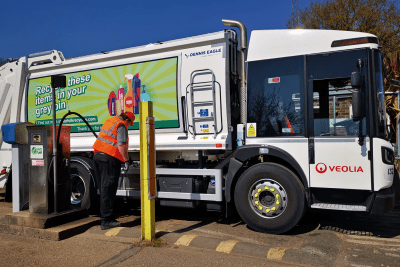
The announcement followed the start of Veolia’s contract with Broadland District Council this month, which involved commitments to reduce operational emissions and develop low carbon solutions.
Veolia states that every vehicle in the ‘renewable fuelled’ fleet is powered by Hydrotreated Vegetable Oil (HVO), a bio-based liquid fuel made from vegetable oils and animal fats.
According to Veolia, HVO eliminates up to 90 per cent of net CO2 and reduces nitrogen oxide (NOX), particulate matter (PM) and carbon monoxide (CO) emissions. The company also said that HVO is fully interchangeable with diesel and can be used pure or blended with fossil diesel if required.
Pascal Hauret, Managing Director Municipal, Veolia UK said: “We’re delighted to launch our first fully HVO powered fleet in Broadland. HVO significantly reduces CO2 emissions so this is a hugely positive step in our shared commitment to net zero.
“Importantly, whilst the availability of HVO is still limited in the UK, Veolia has secured a guaranteed supply for the entire contract term. As part of our ambitious and achievable carbon reduction plan, this new fleet will help drive us towards our 2050 Net Zero ambitions.”
Councillor Judy Leggett, portfolio holder for Environmental Excellence, said: “We're very pleased to be continuing our very successful working relationship with Veolia through the award of this major new contract.
“The contract brings together an excellent service for residents with innovative new approaches which will help to make our waste and recycling services more effective and even more environmentally friendly.”


Get our weekly digest
resource.co article ai

How will the government and DMOs address the challenges of including glass in DRS while ensuring a level playing field across the UK?
There's no easy solution to include glass in the DRS while maintaining a level playing field. Potential approaches include a phased introduction of glass, potentially with higher deposits to reflect its logistical challenges. The government and DMOs could incentivise innovation in glass packaging design and subsidise dedicated return points for glass-handling. Exemptions for smaller businesses unable to handle glass might also be necessary. Any successful solution will likely blend several approaches. It must address the differing priorities of devolved administrations, balance environmental benefits with logistical and cost implications, and be supported by robust consumer education campaigns emphasizing the importance of glass recycling.