

University College London's Centre for Behaviour Change will produce the first systems map of paper cup recycling behaviours, consulting stakeholders across retail, waste and policy to inform infrastructure design and intervention strategies.
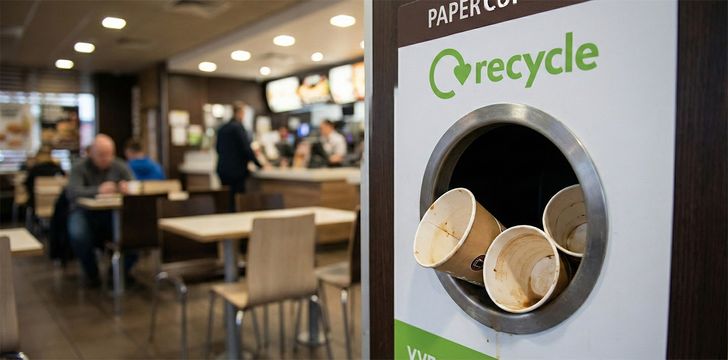
University College London's Centre for Behaviour Change has won over £44,000 to develop the first behavioural systems map focused specifically on paper cup recycling, examining barriers and enablers across the collection system.
The funding, awarded through the National Cup Recycling Scheme's 'Beyond the Bin' project fund competition, will support an eight-month research project to identify key behaviours, barriers and enablers in paper cup recycling, and guide future policy development.
The UK uses approximately 2.5 billion disposable paper cups annually, yet recycling rates remain low. The National Cup Recycling Scheme, administered by Valpak by Reconomy, reports that 227 million cups have been recycled since the scheme's launch in 2018. The scheme is funded by Costa Coffee, McDonald's, Pret a Manger, Caffè Nero, Lavazza Professional, Greggs and Burger King.
Behavioural science approach
The UCL project will use the COM-B behaviour model, developed by the Centre for Behaviour Change, which analyses capability, opportunity and motivation as factors influencing behaviour. The model has been applied across health, sustainability and policy contexts to design targeted interventions.
The research will consult stakeholders across retail, waste management, manufacturing and policy sectors, and will include analysis using system effects software. A rapid literature review will integrate academic and stakeholder insights, while a detailed case study of an existing intervention will be developed in collaboration with the National Cup Recycling Scheme.
Hannah Osman, Manager of the National Cup Recycling Scheme, said the UCL bid aligned with scheme ambitions. "It was a particularly close call between the top four finalists, but UCL's bid is a worthy winner," she said. "The findings can directly inform future infrastructure design, communication strategies, and the goals of the project closely align with our ambitions to prevent cups from ending up in landfill."
Industry context
The award comes as the sector navigates uncertainty around future regulation. The UK Government cancelled plans for a mandatory cup takeback scheme in December 2024, citing implementation costs of £52 million and limited projected environmental benefits. The scheme, originally proposed under Extended Producer Responsibility regulations, would have required businesses with ten or more full-time staff to provide dedicated collection bins and arrange recycling services.
Matt Spencer, Commercial Director and Group Head of Sustainability for Caffè Nero, said the research would address systemic challenges. "We know further improving recycling rates isn't just about infrastructure, it's about understanding behaviour across the whole system," Spencer said. "We hope that UCL's work will provide valuable insight to help retailers, policymakers and waste partners design solutions that make recycling easier, clearer and more effective for customers."
The Beyond the Bin competition received submissions covering research and evidence building, recycling and infrastructure improvements, and awareness campaigns. Close runners-up included RECOUP, which proposed research into barriers to integrating paper cups into mainstream recycling systems; Recorra, which planned a dual reuse and recycling cup system across the Broadgate Estate in the City of London; and Immersive Industry Experiences, which offered an awareness campaign using live-action immersive storytelling for young people.


Get our weekly digest
resource.co article ai

How will the government and DMOs address the challenges of including glass in DRS while ensuring a level playing field across the UK?
There's no easy solution to include glass in the DRS while maintaining a level playing field. Potential approaches include a phased introduction of glass, potentially with higher deposits to reflect its logistical challenges. The government and DMOs could incentivise innovation in glass packaging design and subsidise dedicated return points for glass-handling. Exemptions for smaller businesses unable to handle glass might also be necessary. Any successful solution will likely blend several approaches. It must address the differing priorities of devolved administrations, balance environmental benefits with logistical and cost implications, and be supported by robust consumer education campaigns emphasizing the importance of glass recycling.