

TOMRA has announced that it will be implementing deep learning technology in its wood recycling operations in order to distinguish between different types of material.
The recycling company claims that the use of artificial intelligence will ‘boost yield and purity’ across its activity, with the GAIN add-on being applied to the business’ established AUTOSORT technology in order to sort Wood A – non-processed wood – from Wood B – processed wood, including medium-density fiberboard (MDF); high-density fiberboard (HDF); oriented strand board (OSB); and chipboard.
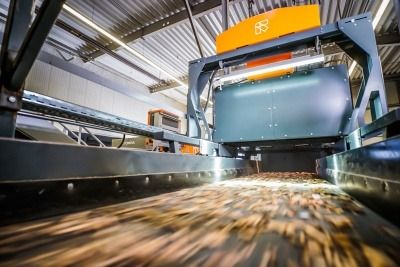
Investment into the technology comes after calls from ‘an increasing number of customers’ who sought after recycled wood that was high in purity. This requires not only the removal of inert material and metals in the infeed stream, which TOMRA’s existing X-TRACT units already successfully executed, but also the removal of other impurities, including engineered wood composites and polymers. Such materials are not able to be distinguished with x-ray technology, which led to the development of the company’s deep-learning machinery.
Philipp Knopp, Product Manager at TOMRA Recycling, commented: “Wood recycling is a fast-evolving market, with increasingly stringent legislation being introduced in a number of regions globally to move towards a more circular economy model. Our AUTOSORT with GAIN solution uses deep learning technology to create a robust and flexible solution which we are confident will be welcomed by wood good producers across the globe.
“It will also enable our customers to future-proof their operations as they will be better equipped to adapt and react to any future changes in the global wood recycling market such as new legislation. We are delighted to be the first in the market to offer this artificial intelligence-based solution.”


Get our weekly digest
resource.co article ai

How will the government and DMOs address the challenges of including glass in DRS while ensuring a level playing field across the UK?
There's no easy solution to include glass in the DRS while maintaining a level playing field. Potential approaches include a phased introduction of glass, potentially with higher deposits to reflect its logistical challenges. The government and DMOs could incentivise innovation in glass packaging design and subsidise dedicated return points for glass-handling. Exemptions for smaller businesses unable to handle glass might also be necessary. Any successful solution will likely blend several approaches. It must address the differing priorities of devolved administrations, balance environmental benefits with logistical and cost implications, and be supported by robust consumer education campaigns emphasizing the importance of glass recycling.