

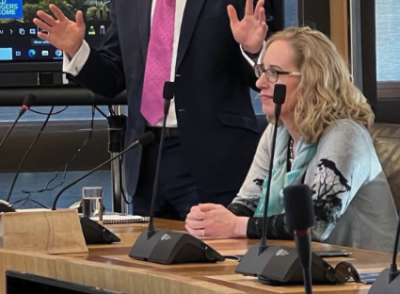
Minister for Green Skills, Circular Economy and Biodiversity Lorna Slater confirmed in Scottish Parliament on Wednesday (19 April) that the Scottish Government will be consulting on the mandatory collection of textiles by local authorities by 2025.
The move is a possible sign that Scotland may still uphold the commitment made before Brexit to introduce mandatory textile collections by 2025, as part of the EU’s Waste Framework Directive (WFD).
The announcement came during a launch event to present research from the University of Glasgow and outline the white paper ‘Evidencing the Need for a National Citizens Clothing Circularity Strategy’ by Dr Lynn Wilson, Professor Deirdre Shaw and Dr Katherine Duffy.
The announcement also follows the release of an analysis of responses to the 2022 consultation on ‘Delivering Scotland's Circular Economy: Route map to 2025 and Beyond’. Despite the Route Map to 2025 consultation having called for responses on the introduction of mandatory collection of textiles, the analysis does not touch on this topic.
Alongside collections, the Route Map to 2025 consultation also called for responses to a proposed mandatory reporting of waste and surplus food and textiles by businesses. The responses to this call are also absent from the analysis.
Lorna Slater has recently been criticised for her work on the Scottish deposit return scheme (DRS). The scheme was delayed by First Minister Humza Yousaf from August 2023 to March 2024 earlier this week. Scotland’s Labour Party has called for Yousaf to remove the DRS from Slater’s ministerial duties.
Alan Wheeler, CEO of the Textile Recycling Association, commented: “We welcome the statement from the Green Skills Minister Lorna Slater that the Scottish Government is still committed to consulting upon the introduction of mandatory collections of textiles for local authorities by 2025. I would like to repeat the invitation that I made on behalf of the Textile Recycling Association to work with her, the Scottish Government and Zero Waste Scotland to deliver the best outcome from this.
“Whilst this could be a vital tool for delivering a circular textiles economy in Scotland, there will still be a necessity to deliver policy interventions elsewhere to create new markets for used textiles and to encourage investment in new technologies that improve economic and logistical efficiencies in collections, sorting and processing.
“An Extended Producer Responsibility scheme for textiles was referred to at the event this week, but other interventions such as product design standards, minimum recycled content in new products and an agreed end of waste status are just some of the other proposals that should be considered.”
Peter Page, Group Head of Recycling at Textile Recycling International, added: “I think it’s excellent the Scottish government are going to be consulting on this initiative, and getting this right will be paramount in reducing the number of textiles that go to landfill each year, textiles collected at the kerbside does not work for numerous reasons predominately the Scottish weather and not having a weatherproof receptacle.
“Further thought should be on increasing textile collection points across Scotland. Over the past ten years councils have increasingly removed these leaving members of the public less opportunity to recycle. Another thought should be on a dedicated doorstep collection service for textiles.”
The EU’s Waste Framework Directive and textiles legislation
The EU’s WFD sets the basic standards for all waste collection by EU member states. A 2018 revision mandated that by 1 January 2025, all member states must have introduced separate collections for textiles – although it does not specify that collections must be kerbside.
When the UK left the EU, Westminster initially expressed its intention to uphold the commitment to introduce mandatory collections of used textiles by 2025. However, the Government’s current intentions are unclear.
Some EU member states have already implemented mandatory collections ahead of the WFD coming into effect. For example, Finland’s law came into force in January this year, following a series of trials.
The WFD also states that extended producer responsibility (EPR) for textiles will be introduced as one of the targeted revisions of the WFD, currently scheduled to be implemented this year.
Defra Secretary of State, Thérèse Coffey, has said that the UK Government currently does not have any plans to introduce an EPR scheme for textiles.


Get our weekly digest
resource.co article ai

How will the government and DMOs address the challenges of including glass in DRS while ensuring a level playing field across the UK?
There's no easy solution to include glass in the DRS while maintaining a level playing field. Potential approaches include a phased introduction of glass, potentially with higher deposits to reflect its logistical challenges. The government and DMOs could incentivise innovation in glass packaging design and subsidise dedicated return points for glass-handling. Exemptions for smaller businesses unable to handle glass might also be necessary. Any successful solution will likely blend several approaches. It must address the differing priorities of devolved administrations, balance environmental benefits with logistical and cost implications, and be supported by robust consumer education campaigns emphasizing the importance of glass recycling.