

Plantics and Vepa, Carbios and LanzaTech have been announced as the three winners of the Renewable Material of the Year award on the third and final day of this year’s Renewable Materials Conference, which took place from 18-20 May.
nova-Institute hosted this year’s online conference, which was organised with the help of partners including European Bioplastics, the Bio-based and Biodegradable Industries Association (BBIA) and the Renewable Carbon Initiative.
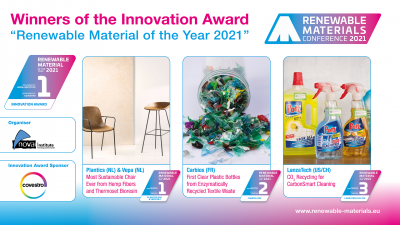
The Renewable Material of the Year award, which was announced on the final day of the conference, was sponsored by Covestro, among others.
The first day of the conference focused on building blocks and chemicals, the second on polymers and plastics and the third on plastic and composite materials.
The six nominees for the Renewable Material of the Year award were: MMAtwo from the European Union, Eastman from the US, Malai Biomaterials Design from India, Carbios from France, Plantics and Vega from the Netherlands and LanzaTech from the US and Switzerland.
The latter three companies were announced as the winners of the award.
Plantics and Vega, a Dutch venture, uses hemp fibre to create a bio-based resin, which it has used to coat its collection of chairs and other furniture. The process is said to absorb more CO2 than it emits, and the chairs are designed to be taken apart and recycled or reused.
French company Carbios develops biological processes to break down PET plastic waste into basic monomers, which produces new virgin PET plastics. The enzymatic process enables polyester fibres to be ‘upcycled’ into PET suitable to be made into clear plastic bottles.
LanzaTech, a collaboration between Swiss retailer Migros and CarbonSmart technology, has seen Migros launch a range of cleaning products that contain LanzaTech’s CarbonSmart ethanol, which is produced from recycled carbon from steel emissions.


Get our weekly digest
resource.co article ai

How will the government and DMOs address the challenges of including glass in DRS while ensuring a level playing field across the UK?
There's no easy solution to include glass in the DRS while maintaining a level playing field. Potential approaches include a phased introduction of glass, potentially with higher deposits to reflect its logistical challenges. The government and DMOs could incentivise innovation in glass packaging design and subsidise dedicated return points for glass-handling. Exemptions for smaller businesses unable to handle glass might also be necessary. Any successful solution will likely blend several approaches. It must address the differing priorities of devolved administrations, balance environmental benefits with logistical and cost implications, and be supported by robust consumer education campaigns emphasizing the importance of glass recycling.