

Proctor & Gamble (P&G) has unveiled its first paper bottle for Lenor in partnership with paper bottle company Paboco, announcing a pilot to be rolled out across Western Europe in 2022.
The trial rollout will form the basis of a test and learn strategy, wherein the pilot will be tested on a small number of customers to predict wider impact, ready for scaling up and incorporation across P&G’s portfolio if successful.
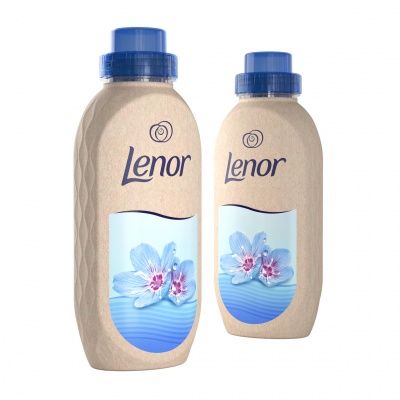
The bottle will be made from Forest Stewardship Council (FSC) certified molded paper and, in its initial stages, a plastic barrier made from post-consumer recycled polyethylene terephthalate (PET).
P&G states that this design will be developed upon, with future versions of the bottle integrating the barrier into the paper lining, in order to create what the company refers to as a recyclable ‘100 per cent bio-based bottle’.
P&G claims that this development will form part of its 2030 Ambition, in which the company aims to see a 50 per cent reduction in its use of virgin plastics by 2030.
It believes that brand-led packaging alternatives and pilot schemes are a ‘crucial element’ in the pathways to lowering environmental impact.
The consumer goods company asserts that Paboco’s paper bottle technology will reduce and replace the plastic of conventional packaging, presenting a ‘100 per cent bio-based and recyclable paper bottle at scale’.
Jerry Porter, Senior Vice President of R&D for the Global Fabric and Home Care Sector of P&G, commented: “We’re very excited to join this group of packaging innovators.
“This is another milestone on our P&G Fabric and Home Care journey to innovate towards more sustainable packaging formats.
“Our chosen pilot brand Lenor has a great track record of incorporating recycled plastic into its packaging, already using up to 100 per cent in its European transparent bottles.
“Now we aim to go a step further with bio-based packaging, which has a very promising future.
“We are delighted to be on this journey with our partners in the development of the next generations of paper bottles.”
Speaking on behalf of Paboco, interim CEO, Gittan Schiöld, said: “Our vision is to change this industry for good, and to create a world less dependent on plastic and without plastic waste, by designing for circularity and inventing packaging from bio-based materials.
“Storing liquids in paper is particularly challenging, but its successful adoption could have major benefits for the planet.
“Having P&G Fabric and Home Care category as a partner in the paper bottle community is a huge boost to that vision.
“Not only does it really add weight to the viability of the technology but brings with it P&G’s know-how to the table, offering new opportunities for scaling Paboco’s paper bottle technology.”


Get our weekly digest
resource.co article ai

How will the government and DMOs address the challenges of including glass in DRS while ensuring a level playing field across the UK?
There's no easy solution to include glass in the DRS while maintaining a level playing field. Potential approaches include a phased introduction of glass, potentially with higher deposits to reflect its logistical challenges. The government and DMOs could incentivise innovation in glass packaging design and subsidise dedicated return points for glass-handling. Exemptions for smaller businesses unable to handle glass might also be necessary. Any successful solution will likely blend several approaches. It must address the differing priorities of devolved administrations, balance environmental benefits with logistical and cost implications, and be supported by robust consumer education campaigns emphasizing the importance of glass recycling.