

The Department of Agriculture, Environment and Rural Affairs has opened a three-month consultation on its draft waste strategy, setting recycling and landfill reduction targets alongside new extended producer responsibility schemes and a deposit return system for drinks containers.
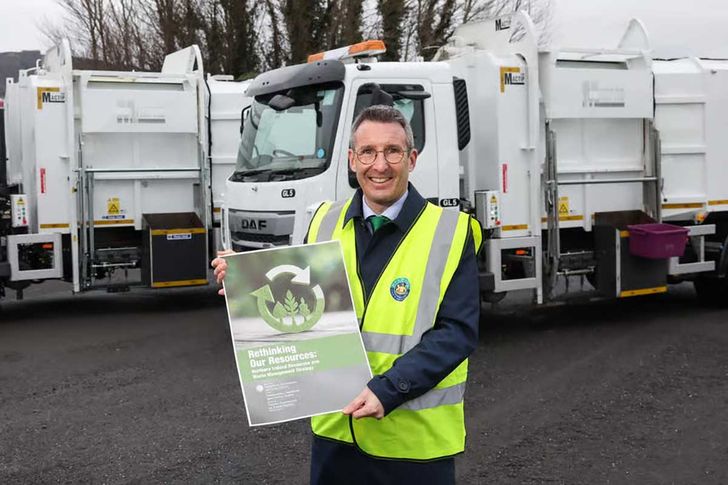
Northern Ireland is seeking views on a new waste strategy that would push controlled waste recycling to 70 per cent by 2030 while capping landfill at 10 per cent by 2035.
The Department of Agriculture, Environment and Rural Affairs (DAERA) opened the three-month consultation on 15 January, with Minister Andrew Muir describing the draft strategy as an opportunity to shift from "take, make, use and dispose" towards a circular economy built on reduction, reuse, repair and recycling.
"By prioritising waste reduction, reuse, repair and recycling we can unlock a host of benefits whether it be environmental gains by reducing the amount of waste sent to landfill, economic opportunities by embracing circular practices stimulating innovation, creating green jobs and supporting local businesses alongside greater resource efficiency and community resilience," Muir said.
The strategy document notes that 92.1 per cent of the 33.6 million tonnes of material used annually in Northern Ireland never cycles back into the economy. While some supports long-lasting infrastructure, the strategy identifies scope to increase material recovery substantially.
The draft Rethinking Our Resources strategy sets out 63 actions across seven waste streams. For council waste specifically, recycling targets rise from 55 per cent by 2025 to 60 per cent by 2030 and 65 per cent by 2035.
Producer responsibility reforms
The strategy sets targets for flexible plastic packaging to be collected for recycling from households by March 2027.
Producer responsibility schemes for waste electrical and electronic equipment will be reformed by June 2027, followed by batteries in December 2027. The end-of-life vehicles scheme will be developed to meet requirements under the Windsor Framework, which keeps Northern Ireland aligned with EU directives including waste regulations as part of maintaining the single market for goods.
A deposit return scheme for single-use drinks containers will be introduced by December 2027.
Councils will develop guidance by March 2027 for a core set of recyclable materials including glass bottles, paper and card, plastic bottles, pots, tubs and trays, cartons and metal packaging. Plastic film will join the core set later in 2027.
Recycling performance and targets
Northern Ireland's recycling rate has barely budged in recent years. Latest statistics from DAERA show it held at 50.4 per cent in 2024/25, with household waste recycling at 51 per cent.
The 11 councils collected just over one million tonnes of waste during the year, up one per cent on the previous year. Landfill dropped to a record low of 14 per cent from 18.4 per cent in 2023/24, as energy recovery climbed to 34.3 per cent from 29.7 per cent.
While the household recycling rate exceeds the 50 per cent target set in the 2013 strategy for 2020, Northern Ireland has not reached the more ambitious 60 per cent target for local authority collected municipal waste.
Northern Ireland recycles more than England at 44 per cent and Scotland at 42.1 per cent, according to 2023 UK data, though it trails Wales at 57 per cent.
Food waste and infrastructure
All councils will be required to provide food waste collections to all households, with existing services enhanced to boost capture rates. A Household Waste Recycling Collaborative Change Programme will fund councils to transform kerbside recycling and food waste collections.
The strategy addresses seven waste categories: household waste, non-household municipal waste, commercial and industrial waste, construction and demolition waste, hazardous waste, agricultural waste, and litter and fly-tipping.
Between 2026 and 2035, a series of legislative and policy interventions from the UK Government and the Northern Ireland Assembly will reshape how waste is managed.
DAERA will develop multi-year communications programmes for waste and recycling, and work to update skills and training to support the transition to a circular economy.
Digital waste tracking will be rolled out across the UK by October 2026, with Northern Ireland working alongside other devolved administrations on the mandatory system.
In his ministerial foreword, Muir highlighted Northern Ireland's legally binding Net Zero commitment by 2050 under the Climate Change Act (NI) 2022, describing the resources and waste management sector as playing a critical role in meeting that target.
"I would encourage anyone who wants to help shape sustainable resource management and circular innovation towards a low-carbon, circular economy to have their say," Muir said.
The consultation closes at 23:59 on 8 April.


Get our weekly digest
resource.co article ai

How will the government and DMOs address the challenges of including glass in DRS while ensuring a level playing field across the UK?
There's no easy solution to include glass in the DRS while maintaining a level playing field. Potential approaches include a phased introduction of glass, potentially with higher deposits to reflect its logistical challenges. The government and DMOs could incentivise innovation in glass packaging design and subsidise dedicated return points for glass-handling. Exemptions for smaller businesses unable to handle glass might also be necessary. Any successful solution will likely blend several approaches. It must address the differing priorities of devolved administrations, balance environmental benefits with logistical and cost implications, and be supported by robust consumer education campaigns emphasizing the importance of glass recycling.