

In a new clinical waste strategy, the NHS has committed to reducing carbon emissions from waste by 50 per cent by 2025/26, and to save £11 million annually in recurrent revenue costs through new waste management practices by 2033.
The NHS has committed to reduce its carbon emissions from waste by 50 per cent by 2025/26, its overall carbon emissions by 30 per cent and save the service £11 million annually – 15 per cent of current expenditure – by 2033. The targets are set in a new clinical waste strategy released on Wednesday (7 March) which applies to NHS trusts, NHS foundation trusts and primary care.
The strategy is accompanied by a waste planning tool which was developed to help set the direction, trajectory, and speed of change necessary to reach the NHS target of net zero for direct carbon emissions by 2040, and net zero for indirect carbon emissions by 2045.
Every year, NHS providers produce approximately 156,000 tonnes of clinical waste that are either sent to high-temperature incineration (HTI) or for alternative treatment (AT). The estimated carbon impact of this waste is approximately 100,000 tonnes of CO2e per year.
The strategy focuses on six key areas: data, workforce, compliance, commercial, infrastructure and sustainability. These are grouped into larger themes of productivity, resilience and net zero carbon (NZC). The below table, provided by the NHS, summarises the details of priority, intervention, and measurement in each area:

Clinical waste is defined by the controlled waste regulations as the following:
- Waste containing viable micro-organisms or their toxins which are known or reliably believed to cause disease in humans or other living organisms;
- Waste which contains or is contaminated with a medicine that contains a biologically active pharmaceutical agent;
- Sharp waste, body fluids or other biological material (including human and animal tissue) containing or contaminated with a dangerous substance as defined by the Classification, Labelling, and Packaging Regulation.
Offensive waste (OW) refers to waste that has no hazardous properties and can be treated or disposed of in a similar manner to municipal waste.
This form of waste has an expected growth rate of three per cent per annum. As a result, the total clinical waste treated through HTI and AT, combined with OW, is expected to increase from approximately 149,000 tonnes in 2019/20 to an estimated 200,000 tonnes in 2029/30.
Measurement of success for clinical waste strategy
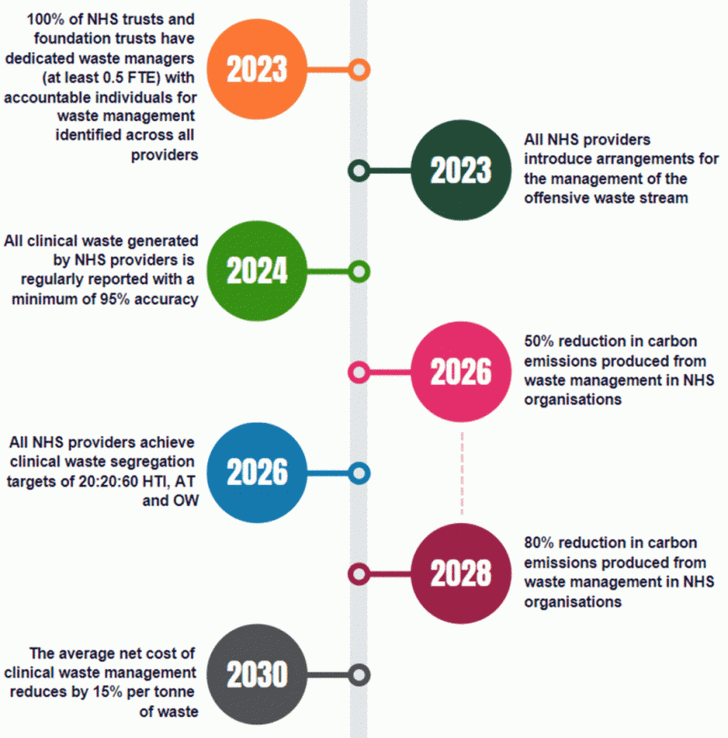
The strategy includes metrics for success. The timeline for these is set out below. The strategy is scheduled for a series of annual reviews and implementation plans for one and three years ahead.
By implementing this strategy, within five years, the NHS hopes to:
- Ensure 100 per cent of NHS providers, including primary care managing agents, have fully trained waste managers;
- Improve waste segregation and compliance;
- Establish a new commercial model to help stabilise the waste management market;
- Drive NHS ownership and control over its own processing assets, with 25 per cent of large and acute teaching hospitals owning their processing capacity thereby improving regional and national resilience;
- Deliver a 30 per cent reduction in carbon emissions from clinical waste segregation; a 50 per cent reduction in the carbon emissions produced from wider waste management by 2025/26, and 80 per cent by 2028 to 2032;
- Ensure there is national support to help providers implement the strategy.
Simon Corben, Director of Estates and Head of Profession of NHS England, said in a foreword to the strategy: “I encourage all NHS providers to embrace and adopt this strategy and embed the steps from the action plan as part of their daily waste management practices.”


Get our weekly digest
resource.co article ai

How will the government and DMOs address the challenges of including glass in DRS while ensuring a level playing field across the UK?
There's no easy solution to include glass in the DRS while maintaining a level playing field. Potential approaches include a phased introduction of glass, potentially with higher deposits to reflect its logistical challenges. The government and DMOs could incentivise innovation in glass packaging design and subsidise dedicated return points for glass-handling. Exemptions for smaller businesses unable to handle glass might also be necessary. Any successful solution will likely blend several approaches. It must address the differing priorities of devolved administrations, balance environmental benefits with logistical and cost implications, and be supported by robust consumer education campaigns emphasizing the importance of glass recycling.