

Supermarkets have announced a collaboration supported by Governments and WRAP to explore an industry-wide system to replace single-use plastics
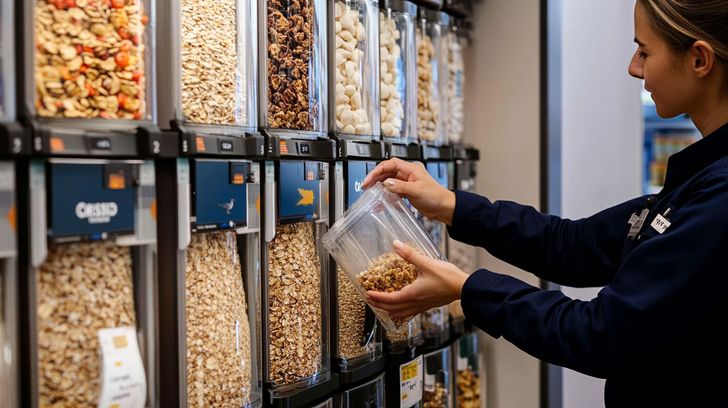
Nine of the UK’s leading supermarkets have issued a joint Statement of Intent to explore the conversion from single-use plastics to reusable packaging.
Working with the support of Defra, the devolved governments and Waste and Resources Action Programme (WRAP), the retailers plan to implement a coordinated system to use reusable packaging in any store.
The retailer signatories of the UK Plastics Pact stated today (15 July 2025): “We, the grocery retailers of the UK (Aldi, Asda, Co-op, Lidl GB, Morrisons, Ocado Retail, Sainsbury’s, Tesco and Waitrose) supported by Innovate UK, WRAP and DEFRA, DAERA, Scottish Government and Welsh Government have a common ambition to work together to enable increased consumer adoption and participation in a circular economy by exploring how reusable packaging (with a focus on prefill) could be implemented through interoperable systems.
Recognising the challenges to achieving this at scale, we intend to collaborate on an approach that has the potential to deliver a reduction in single use packaging by 2030.”
This comes against the backdrop of shifting public sentiment, with a recent poll finding that two thirds of the UK public want reuse and refill stations in supermarkets.
James Bull, Chair of the retailer group, stated that by working together the companies can deliver a step-change in packaging sustainability: “Unlocking reuse for UK retailers and their customers will only be achieved through collaboration and shared goals.
“Today’s joint statement of intent is an important first step in realising our collective ambition. It also signposts to our wider supply chains our intent to build reuse at scale, increase circularity in our packaging and help customers move away from single use to a more reusable future.”
Potential benefits of the packaging transition
Based on the UK Plastics Pact Annual Report 2024, 70 per cent of plastic packaging is now reusable or recyclable, representing significant progress since 2018 but falling short of the target for 100 per cent of plastic packaging to be reusable, recyclable or compostable by 2025.
Data from GoUnpackaged suggests that a 30 per cent transition to reusable packaging could cause significant financial and environmental benefits for the UK. This includes a £136 million yearly saving on packaging EPR costs for producers, a 95 per cent reduction in CO2e emissions and the creation of 13,000 new jobs.
According to the data, this 30 per cent conversion to reuse could be achieved by focusing on 18 priority product categories which have been identified as the most suitable to switch, such
as coffee, shower gel and ready meals.
Competing grocery retailers set to collaborate
Earlier this year, a trial by the Refill Coalition, that included Aldi and Ocado, found that both in-store refill stations and online returnable containers can be commercially viable and environmentally beneficial when deployed at scale.
Based on learnings from previous localised pilots, today’s initiative marks a step forward with grocery retailers representing almost 95 per cent of the UK market taking a co-ordinated approach to reusable packaging.
Commenting on the collaboration, Paul Davidson, Challenge Director of the Smart Sustainable Plastic Packaging (SSPP) Challenge said, “Reuse has always been a high priority for Innovate UK’s Smart Sustainable Plastic Challenge (SSPP) and directly contributes to the delivery of the UK Plastics Pact targets, we recognised that achieving an interoperable system was the next logical step.
“SSPP convened the grocery retailers in an Innovation Lab setting for three days to forge a collaborative approach and we are delighted to see this statement of intent as a tangible outcome.’’
WRAP is supporting the group to align goals, infrastructure and consumer needs, acting as a secretariat. Keith James, Interim Director for Behaviour Change & Business Programmes WRAP said that the commitment ‘marks a bold step towards a future where reusable packaging is the norm, not the exception’.
He added: “It shows what is possible when we work with retailers and governments with a shared purpose that can benefit everyone.”
The process continues in September where a webinar will be held for brands, manufacturers and suppliers to engage with the Reuse Packaging Partnership.


Get our weekly digest
resource.co article ai

How will the government and DMOs address the challenges of including glass in DRS while ensuring a level playing field across the UK?
There's no easy solution to include glass in the DRS while maintaining a level playing field. Potential approaches include a phased introduction of glass, potentially with higher deposits to reflect its logistical challenges. The government and DMOs could incentivise innovation in glass packaging design and subsidise dedicated return points for glass-handling. Exemptions for smaller businesses unable to handle glass might also be necessary. Any successful solution will likely blend several approaches. It must address the differing priorities of devolved administrations, balance environmental benefits with logistical and cost implications, and be supported by robust consumer education campaigns emphasizing the importance of glass recycling.