

A House of Lords committee has criticised the Environment Agency's "demonstrable inadequacy" in responding to serious waste crime and called for an independent review to be completed by May 2027, following evidence of systemic enforcement failures.
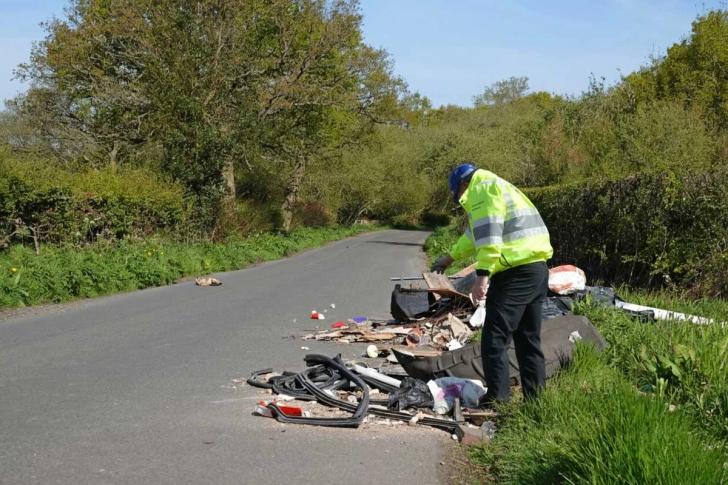
The House of Lords Environment and Climate Change Committee has called for an independent "root and branch review" of England's response to waste crime, following an inquiry that heard evidence of systemic failures by the Environment Agency (EA).
In a letter to Emma Reynolds, Defra’s Secretary of State, the Committee’s Chair Baroness Sheehan wrote that they had heard "credible evidence of numerous specific examples" in which the Environment Agency's has failed to tackle serious and organised waste crime. An issue that costs the UK economy approximately £1 billion a year.
The committee concluded that waste crime is "critically under-prioritised despite its significant environmental, economic and social costs" and questioned whether "incompetence at the Environment Agency has not been a factor" in enforcement failures.
The letter highlights the case of Hoad's Wood in Kent, where 30,000 tonnes of waste was illegally dumped in a Site of Special Scientific Interest between 2020 and 2023. The Environment Agency did not obtain a restriction order until January 2024, and the taxpayer-funded clean-up is expected to cost up to £15 million – almost equivalent to the EA's entire annual budget for waste crime.
The committee noted that six other illegal waste sites of similar or greater size currently exist across England, which Baroness Sheehan says "points to a fundamentally broken system."
Matthew Scott, Police and Crime Commissioner for Kent, told the inquiry that members of the public reporting waste crime face a "merry-go-round" between agencies, with reports passed between borough councils, police and the Environment Agency without any organisation taking ownership.
Police engagement criticised
The committee expressed concern about the "lack of interest shown by the police" in tackling serious and organised waste crime, which was described as "the new narcotics" by the former CEO of the Environment Agency.
The National Crime Agency informed the committee that waste crime is not a strategic priority threat for the agency, though it will contribute to partner-led efforts when certain thresholds are met.
The committee heard that approximately 38 million tonnes of waste – enough to fill Wembley Stadium 35 times – is believed to be illegally managed at some point in the waste management chain each year. However, waste crime is substantially underreported, with only 27 per cent of incidents estimated to be reported.
Resource imbalance criticised
The inquiry heard evidence that the Environment Agency's 14 local environmental crime teams dealing with outright criminality are significantly under-resourced, whilst the regulator "heavy-handedly" regulates permitted waste sites for minor infractions.
Dr Anna Willetts, from the UK Environmental Law Association, told the committee that eight EA officers might inspect a regulated site for a minor compliance issue, whilst serious illegal sites nearby go unaddressed because the EA cannot use permit income to tackle operators outside the regulatory framework.
The EA's baseline budget to tackle waste crime remained at £10 million from April 2018, though Defra states that it has now increased it to £15.6 million for this year. The department added that the Joint Unit for Waste Crime has nearly doubled in size, with the EA increasing its frontline criminal enforcement resource by 43 full-time employees.
The committee heard that every £1 spent tackling waste crime generates approximately £5 in benefit through tax income, business for legitimate operators and avoided environmental and social harm. However, the current £15.6 million enforcement budget represents just 1.6 per cent of the estimated £1 billion annual cost of waste crime to the economy.
Mr Scott told the inquiry that he understands just 5.5 full-time equivalent investigators cover the area from Dorset to Dover.
The committee raised concerns about the effectiveness of EA prosecutions, noting that criminal penalties do not reflect the seriousness of waste offences and are insufficient to deter serious and organised crime.
In the three years to March 2025, the EA received over 24,000 reports of waste crime but opened only 320 criminal investigations. During this period, 156 prosecutions were brought, alongside other enforcement actions including 1,037 advice and guidance letters and 685 warning letters.
The Joint Unit for Waste Crime, established five years ago to coordinate partnership working, has led or supported 129 operations resulting in 186 arrests. However, the unit does not know how many convictions its work has led to, as prosecutions for non-environmental offences are brought by other agencies.
Key recommendations
The committee's overarching recommendation calls for an independent review of the response to waste crime, covering the extent and effectiveness of integrated working among the Environment Agency, HMRC, National Crime Agency, policing and local authorities. The committee recommended that the review should be completed and the government respond by May 2027 at the latest.
Other recommendations include developing interim targets with comprehensive metrics published quarterly; establishing a single telephone number and web portal for reporting waste crime; maintaining the increased funding provided to the EA this year; and reviewing Treasury rules that prevent the Environment Agency from using environmental permit income to support waste crime enforcement.
The committee also called for the government to fully assess risks that proposed landfill tax reforms could increase other forms of waste crime and lead to the abandonment of landfill sites before implementing the Treasury's proposed unification of landfill tax rates by 2030.
Government and EA response
An Environment Agency spokesperson commented: "Waste crime is toxic and causes serious harm to people, places, the environment, and the economy. We recognise the recommendations of the report and are committed to doing more.
"Last year alone, our dedicated teams shut down 462 illegal waste sites and prevented nearly 34,000 tonnes of waste being illegally exported – showing that we can make real change despite the challenges involved."
A Defra spokesperson added: "This Government is taking action to clean up Britain and tackle waste gangs. Under our Plan for Change, we are tightening the net on gangs exploiting our waste system by helping councils to crush fly-tippers' vans, funding more Environment Agency enforcement officers and imposing tougher sentences for those who transport waste illegally. We will carefully consider the recommendations of this report and will respond in due course."
The government must respond to the committee's recommendations by 9 December 2025.
Defra confirmed that mandatory digital waste tracking will become available for all permitted and licensed sites receiving waste in April 2026 and mandatory from October 2026 in the first phase, with expansion to other operators planned for April 2027. A further 60 full-time employees have been funded to undertake enforcement activity in relation to new duties under packaging extended producer responsibility and Simpler Recycling.
The department said reforms to the waste carriers, brokers and dealers regime will move regulation from a "light-touch registration system into environmental permitting," introducing tougher background checks for operators and tougher penalties. Defra is also preparing reforms to remove three waste permit exemptions and tighten conditions on seven others.
Industry reaction
Sam Corp, ESA's Head of Regulation, said: "Having listened to evidence from industry and enforcement bodies, the House of Lords Environment and Climate Change Committee reached the conclusion that tackling the scourge of waste crime remains critically under-prioritised and under-resourced, despite the damage and misery it causes – a fact that those on the front-line of waste crime know only to be too true.
"We welcome the recommendations of the committee that Government should undertake an independent review of the current regulatory approach, while taking more immediate action to overhaul the regulations; develop interim targets and bolster the resources of regulatory bodies.
"A failure to invest in enforcement not only allows waste criminals to gain a further stranglehold on the sector but is a false economy, since every pound spent fighting this crime creates five pounds in economic benefit. In the long term, we need to see much stronger enforcement and harsher penalties to deter criminals, and we also need to have in place a more robust permitting regime coupled with digital waste tracking to ensure waste cannot fall into the hands of criminals in the first place."
Dan Cooke, Director of Policy, Communications and External Affairs at CIWM, responded: "CIWM notes and largely concurs with the findings from the House of Lords Environment and Climate Change Committee inquiry, which conclude that serious and organised waste crime is currently under-prioritised relative to its significant impact, and that root and branch review is still required to tackle waste crime much more effectively.
"The negative impact this crime imposes on the professional and legitimate resources and waste sector and on local economies, alongside the wider environmental damage it causes, confirms that tackling waste crime must be treated by Government as a definitive sector and societal priority.
"CIWM fully supports the Committee's call for more effective, integrated enforcement. We recognise that this is a complex issue. There are, however, some promising examples of local authorities, police, regulators, and landowners working together to tackle waste crime and we must learn from these and expand effective approaches.


Get our weekly digest
resource.co article ai

How will the government and DMOs address the challenges of including glass in DRS while ensuring a level playing field across the UK?
There's no easy solution to include glass in the DRS while maintaining a level playing field. Potential approaches include a phased introduction of glass, potentially with higher deposits to reflect its logistical challenges. The government and DMOs could incentivise innovation in glass packaging design and subsidise dedicated return points for glass-handling. Exemptions for smaller businesses unable to handle glass might also be necessary. Any successful solution will likely blend several approaches. It must address the differing priorities of devolved administrations, balance environmental benefits with logistical and cost implications, and be supported by robust consumer education campaigns emphasizing the importance of glass recycling.