

London's four largest waste authorities and major operators have written jointly to the environment minister calling for strengthened regulations and producer responsibility reforms to address rising battery fire incidents costing over £1 billion annually.
A coalition of London waste authorities and major operators has written to environment minister Mary Creagh calling for urgent government intervention to address the escalating problem of lithium-ion battery fires.
The joint letter, signed by North London Waste Authority (NLWA), East London Waste Authority (ELWA), West London Waste Authority (WLWA), Western Riverside Waste Authority (WRWA), LondonEnergy Limited, Biffa, Veolia and FCC Environment, points to a 71 per cent increase in reported waste battery fires between 2022 and 2023, with 1,200 incidents recorded in 2023 according to the National Fire Chiefs Council and Recycle Your Electricals.
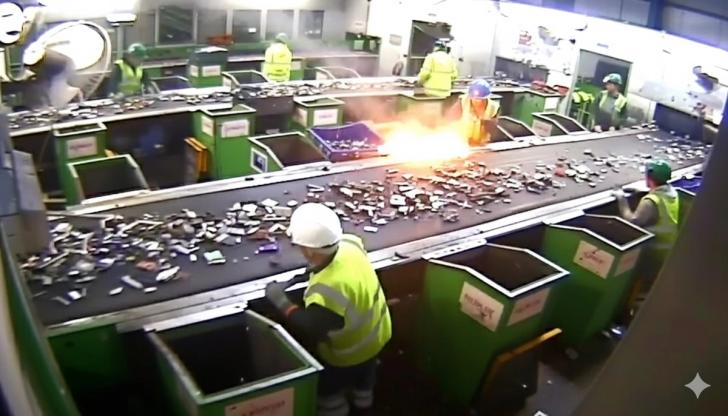
The signatories cite increases in fire incidents at individual facilities. NLWA reported a 53 per cent rise in battery fires between 2023 and 2024, whilst ELWA recorded a 57 per cent increase over the same period. WRWA noted that fires had already risen from eight incidents in 2024/25 to 10 in the current financial year to date.
The letter cites research estimating that battery fires cost over £1 billion per year when accounting for damage to property, vehicles, waste management infrastructure and emergency response services. The signatories also highlight that beyond financial impacts, battery fires pose risks of physical harm to waste operatives and the public, as well as the environmental damage from toxic fumes and contaminated wastewater used in fire suppression.
While acknowledging proactive measures already being taken by operators, including fire suppression systems and communications campaigns such as NLWA's 'Lead the Charge' initiative and Veolia's Dangerous Waste campaign, the letter argues that these efforts alone cannot address the scale of the problem.
Regulatory gaps identified
The coalition recognises the role of the new Waste Electrical and Electronic Equipment (WEEE) regulations, particularly provisions holding online marketplaces accountable, but argues that further action is needed to prevent substandard electrical goods entering the UK market. The letter states that many lithium-ion batteries and chargers sold via third-party sellers originate overseas where safety standards may be lower or poorly enforced.
The signatories call for strengthened border controls and better enforcement of import standards to prevent unsafe products reaching UK homes, workplaces and ultimately the waste stream.
The letter also addresses the existing Extended Producer Responsibility (EPR) regime for batteries, established under the 2009 Waste Batteries and Accumulators Regulations. Whilst the created retail take-back schemes and compliance obligations for producers, the signatories argue that regulations have not kept pace with the growth of electrical products, and the failure to to create appropriate disposal behaviour amongst consumers.
The coalition calls for greater strategic direction from the government and urges Defra to bring forward promised policy interventions, including a review of battery regulations to encourage proper disposal and improve recycling rates, as well as proposals for convenient, funded kerbside collections of waste electricals through EPR.


Get our weekly digest
resource.co article ai

How will the government and DMOs address the challenges of including glass in DRS while ensuring a level playing field across the UK?
There's no easy solution to include glass in the DRS while maintaining a level playing field. Potential approaches include a phased introduction of glass, potentially with higher deposits to reflect its logistical challenges. The government and DMOs could incentivise innovation in glass packaging design and subsidise dedicated return points for glass-handling. Exemptions for smaller businesses unable to handle glass might also be necessary. Any successful solution will likely blend several approaches. It must address the differing priorities of devolved administrations, balance environmental benefits with logistical and cost implications, and be supported by robust consumer education campaigns emphasizing the importance of glass recycling.