

Ireland has announced its first national circular economy strategy, building on the Government’s aim to reduce overall greenhouse gas emissions by 51 per cent by 2030, and reach Net Zero by 2050.
The Government Circular Economy Strategy aims to meet commitments made in the Irish Government’s Programme for Government and the Climate Act 2021. It combines a transition away from fossil fuels, which covers 55 per cent of the targeted emissions, with circularity in manufacturing, which addresses the remaining 45 per cent, according to the Irish Government.
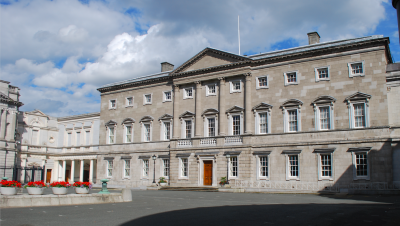
Transitioning all sectors of the economy towards circularity is a specific commitment outlined in the nation’s Waste Action Plan for a Circular Economy (WAPCE). It calls for policy coherence across government in order to ensure ‘all policy levers are set towards the same, sustainable objectives.’ Focus is shifted away from the disposal of waste and instead towards the preservation of resources, with the establishment of a concrete policy framework ensuring that a vision of circularity can be turned into ‘tangible actions and results’.
According to the report, ‘much of the specific context for circular economy activity in Ireland derives from EU policy and legislation’. The Strategy is based on existing European initiatives to realign the economy towards a more circular model, including the European Green Deal, whose legislation culminated in the publication of the Second Circular Economy Action Plan in March 2020. Rather fittingly, Dublin has also been selected as the host city for the European Circular Economy Hotspot in 2023.
Contents of the report
The report outlines several targets in order for Ireland to fully achieve circularity.
- Providing national policy framework to support the transition to a circular economy and to ‘promote public sector leadership in adopting circular policies and practices’
- Implementing measures that significantly reduce Ireland’s circularity gap so that the national rate is above the EU average by 2030 – such measures will focus on the facets of sustainable production and consumption
- Raising awareness amongst households, business and individuals about the circular economy
- Increasing investment in the circular economy in Ireland, with a view to ‘delivering sustainable, regionally balanced economic growth and employment’
- Identifying and addressing ‘the economic, regulatory and social barriers to Ireland’s transition to a more circular economy’
- Enacting the Circular Economy Bill, which will place the Circular Economy Strategy on a statutory footing, making the ongoing development of circular economy policy a legal requirement of the Government.
The Strategy sets out the framework through which ‘all of these strands may be addressed and, as national circular economy policy develops, ambition matched with fairness and transparency will be the cornerstone of Ireland’s approach’.
One key aspect of the framework is the commitment to introduce a Deposit and Return Scheme (DRS) for plastic bottles (up to three litres in volume) and aluminium cans. During October- November 2020, a public consultation was conducted on DRS design options. On 19 November 2021, the Minister signed the regulations for a Deposit Return Scheme (DRS) which will become operational in 2022.
Mícheál Martin, Ireland’s current Taoiseach, commented: “The move to sustainable consumption and production requires a fundamental shift in how we live our lives, run our businesses and conduct Government. Such a transformation requires unambiguous policy direction and support from across Government. This first Whole of Government Circular Economy Strategy will meet that requirement.
“The circular economy is as much a social and economic agenda as it is an environmental one, and will enable us to turn our climate and environmental challenges into opportunities for all.”
Minister Ossian Smyth, Irish Green Party TD, stated: “This Strategy aims to set out what the Circular Economy is and what it means for Ireland. Almost as importantly, it illustrates what the Circular Economy is not.
“The Circular Economy is not just about better waste management or less plastic pollution or better recycling rates. The Circular Economy is about looking at our ‘throwaway’ economy and recognising that there is a better way, that it is possible to break the cycle of wasteful resource extraction, unsustainable consumption, and unnecessary disposal. Environmental degradation must not be the inevitable consequence of economic growth.”


Get our weekly digest
resource.co article ai

How will the government and DMOs address the challenges of including glass in DRS while ensuring a level playing field across the UK?
There's no easy solution to include glass in the DRS while maintaining a level playing field. Potential approaches include a phased introduction of glass, potentially with higher deposits to reflect its logistical challenges. The government and DMOs could incentivise innovation in glass packaging design and subsidise dedicated return points for glass-handling. Exemptions for smaller businesses unable to handle glass might also be necessary. Any successful solution will likely blend several approaches. It must address the differing priorities of devolved administrations, balance environmental benefits with logistical and cost implications, and be supported by robust consumer education campaigns emphasizing the importance of glass recycling.