

Autonomous drones in Milton Keynes test 'pay-as-you-throw' model which could revolutionise waste collection and reduce council tax bills for households producing less waste.
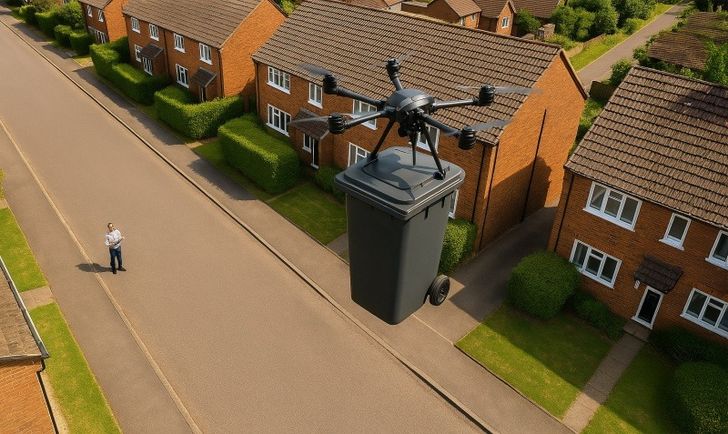
A team of engineers from Cranfield University has launched a trial of autonomous airborne waste collection drones in Milton Keynes, potentially revolutionising how household waste is collected in urban areas.
The six-month pilot programme, which began last week, allows 50 households in the Walton Estate area to request waste collection via a smartphone app when their bins are full, rather than waiting for scheduled collection days.
Professor Lee Bull, Project Lead at Cranfield University's Advanced Aerial Logistics Department, explained: "The SkyBin system completely reimagines waste collection for the digital age. Why should people have bins sitting around for days when they could simply press a button and have their waste flown away within hours? It's absolutely, positively the most revolutionary advancement in waste management since the invention of the bin lid."
The system utilises GPS, vision-camera technology and onboard artificial intelligence to navigate between residential areas and the waste processing depot. Upon arrival, the drone deposits an empty 60-litre bin and collects the full container before returning to the central hub.
Joe Kwonsu, spokesperson for the Department for Environment, Food and Rural Affairs (Defra), noted: "The 60-litre capacity aligns perfectly with our recent calculations on the maximum weekly waste capacity a household should require following the introduction of Simpler Recycling. These flying waste collectors could be the perfect complement to our ongoing efforts to streamline household waste management.
Pay-as-you-throw incentives
A key feature of the trial is the implementation of a pay-as-you-throw payment model, where households are charged only when they request a collection. Participants in the trial receive a rebate on their council tax based on reduced usage of the service.
Ava Larff, Milton Keynes Council's Waste Innovation Officer, commented: "Early data shows participating households have reduced their waste output by 27 per cent since the trial began. When people can see the direct financial benefit of producing less waste, behaviour changes remarkably quickly."
The drones include integrated weight sensors that calculate precise charges for each collection. The app provides users with real-time data on their waste production patterns and suggests ways to reduce waste based on their specific habits.
"We've even built in odour sensors to prioritise collections of particularly pungent bins," added Professor Bull. "The system learns your household's waste patterns and can even predict when you'll need a collection based on your previous behaviour—it's like having a waste management psychic in the sky!"
Technical specifications and safety measures
Each SkyBin drone can lift waste containers weighing up to 15kg and travels at speeds reaching 30km/h. The drones are equipped with LED lights that glow green when approaching a property and red when departing with a full bin.
Safety features include obstacle detection systems, redundant flight controls, and a distinctive musical chime that alerts residents and pedestrians to their presence. After early prototypes faced unexpected challenges from local wildlife, the engineering team implemented "bird avoidance technology" to prevent confused seagulls from attacking the drones.
"We quickly learned that birds, particularly gulls, view the drones as either competition or potential mates," explained Dr. Mave Rricks, the project's wildlife interaction specialist. "The new deterrent system emits ultrasonic frequencies that keep birds at a respectful distance without causing them any distress."
The system has been granted special permission by the Civil Aviation Authority to operate in residential areas, with strict flight corridors established to minimise disruption to residents.
Kwonsu added: "This project is good for British innovation and good for the environment, reducing trucks on the road and cutting carbon emissions. If successful, this could transform how we handle waste collection across the country."
Professor Bull concluded: "In five years, I fully expect bin lorries to be as obsolete as floppy disks. The future of waste management is in the air—quite literally."


Get our weekly digest
resource.co article ai

How will the government and DMOs address the challenges of including glass in DRS while ensuring a level playing field across the UK?
There's no easy solution to include glass in the DRS while maintaining a level playing field. Potential approaches include a phased introduction of glass, potentially with higher deposits to reflect its logistical challenges. The government and DMOs could incentivise innovation in glass packaging design and subsidise dedicated return points for glass-handling. Exemptions for smaller businesses unable to handle glass might also be necessary. Any successful solution will likely blend several approaches. It must address the differing priorities of devolved administrations, balance environmental benefits with logistical and cost implications, and be supported by robust consumer education campaigns emphasizing the importance of glass recycling.