

Environmental charity Hubbub and Starbucks have announced the winners of the ‘Bring It Back’ Fund, created to finance new solutions and systems for sustainable packaging in the food and beverage industry.
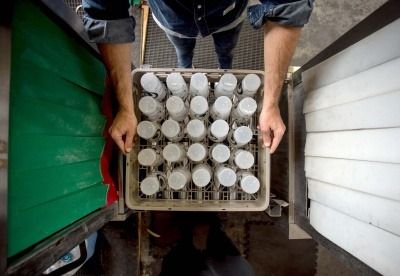
After the application process launched in May, the £1.4 million fund will now be distributed to six ‘reuse solutions’ which are set to be piloted across the UK, with the first project launching in the next few months.
Hubbub and Starbucks have presented the project as a way to test and learn how to shift people’s habits to use alternatives to single-use packaging. This could be done through behaviour-change incentives, research projects, new technology, the expansion of existing successful reuse systems, or developing entirely new service models.
The UK winners are as follows:
- Keep Scotland Beautiful – An environmental charity aiming to pilot a large-scale reusable cup deposit scheme for the first time in Scotland.
- Green Street – A returnable coffee cup and food packaging system in Bradford, working with local cafes and restaurants to trial a reward incentive system with digital rewards platform ‘Maybe’.
- Reath Technology – A female-founded tech solution company based in Edinburgh with the objective of building upon its reuse and RFID technology to create ‘next generation’ reuse tracking software. Reath also aims to generate a customisable footprint calculator for reuse platforms.
- Again – A company operating a network of proprietary packaging cleaning facilities called ‘CleanCells’. In partnership with meal delivery platforms, restaurant chains and independent delivery kitchen operator Karma Kitchen, Again aims to test if doorstep collection of reusable packaging increases the uptake of reuse systems and improves convenience. The trial will take place in central London.
- junee – Partnering with food market Mercato Metropolitano in South London, this reuse-as-a-service startup will test how to eliminate single-use food packaging at the market by making reuse the default option for customers, price competitive for traders, and operationally simple for all parties by connecting logistics and washing support.
- PECT – Aiming to increase reuse, this local environmental charity will research perceptions and barriers around reusable packaging, running behaviour change trials within local communities and specific groups in Peterborough. This will be done in partnership with the charity RECOUP.
The Bring It Back Fund was informed by a recent Censuswide survey of UK adults, to identify common barriers to reuse. The research showed that 41 per cent of people are more worried about how much single-use plastic is used in society since the pandemic started. As well as this, 67 per cent say that they want to reduce the amount of single-use packaging they use when buying food and drink products.
The fund is supported by Starbucks’ 5p cup charge, applied when a customer chooses to use a single-use paper cup. Starbucks has donated all funds of this process, which began in 2018, to Hubbub.
Increasing investment
Gavin Ellis, Director and Co-founder of Hubbub said: “With the Bring It Back Fund, we set out to find innovators with pioneering new approaches to challenge single-use packaging in the food and drink sector.
“We were highly impressed with the quality of the entries received and we are looking forward to working with the winners to tackle this major environmental problem.
“The winning projects offer a strong mix of innovative solutions, from brand new reuse system trials to behaviour change research and funding developments in technology. With this funding, we will be able to test and learn from real-world trials and hopefully demonstrate that reuse systems are safe and easy to use, and can benefit the food and drink industry, consumers and the environment.”
Alex Rayner, General Manager at Starbucks UK, commented: “We’ve introduced an array of different reusable activations over the years to test and trial new ways to encourage reuse. Our latest work with Hubbub, the Bring It Back Fund, builds on our reusables work, aiming to find new ways to inspire people and our customers to choose to reuse.
“It is important for us as a company that we continue to drive industry-wide innovation, as we work to increase reusability and inspire greater reusables uptake in local communities across the UK. This forms part of our long-term goal to reduce waste and become a resource positive company.”
Garance Boullenger, Project Manager of theEllen MacArthur Foundation which focuses on promoting the circular economy, also said: "To solve plastics pollution, there needs to be an increase in investment towards redesigning products and eliminating waste from the beginning.
“It's great to see the growth in funding of impactful innovations in the reuse space, and we look forward to seeing how the learnings from the implementation of these projects can accelerate the transition to a circular economy for plastics."
Dr Garrath Wilson, Senior Lecturer in Experience Design at Loughborough University, added: “With the Bring it Back Fund there is a genuine sense of the coming together of community within each project.
“Although the scale and the localised approaches to applying Circular Economy principles for reuse might differ, each project has a clear sense of whom the change is for and why now is the time to act.
“It is rewarding to have been a part of a process that recognises the value of this and gives vital opportunity where other funding mechanisms may not.”


Get our weekly digest
resource.co article ai

How will the government and DMOs address the challenges of including glass in DRS while ensuring a level playing field across the UK?
There's no easy solution to include glass in the DRS while maintaining a level playing field. Potential approaches include a phased introduction of glass, potentially with higher deposits to reflect its logistical challenges. The government and DMOs could incentivise innovation in glass packaging design and subsidise dedicated return points for glass-handling. Exemptions for smaller businesses unable to handle glass might also be necessary. Any successful solution will likely blend several approaches. It must address the differing priorities of devolved administrations, balance environmental benefits with logistical and cost implications, and be supported by robust consumer education campaigns emphasizing the importance of glass recycling.