

After failed pilots in four markets, Loop's French success demonstrates how regulatory mandates, retailer commitment and financial incentives can enable reuse systems to scale commercially.

In 2019 TerraCycle launched Loop to global fanfare. Never before had a reuse platform been attempted on a worldwide scale.
The benefits of reuse are clear – from reducing waste and emissions to supporting more resilient supply chains. But the path to scale has been anything but easy. Around the world, pilots have launched with optimism only to fade out, including Loop’s own efforts in the US, Canada, the UK and Japan. Six years later, and over $45 million invested, we know that it has failed in all markets except France. But, why did Loop fail to commercially scale after successful pilots in the UK, US., Canada and Japan?
After years of testing, iterations and lessons learned, France has now emerged as a model for how reuse can function at industrial scale across all categories of consumer goods from beverages to food to home care and personal care – providing a global blueprint for countries seeking to implement reuse systems that work for all consumer packaged goods.
In this article I’ll walk you through why Loop and reuse is commercially scaling in France, what we’ve learnt along the way and what is needed in the UK to enable the successful adoption and scaling of reuse.
But first here is some background…
Carrefour, the leading grocer in France, became the first retailer in the world to launch Loop in-store, following an initial e-commerce pilot initiated in 2019. Since then, the retailer has expanded to 345 stores across France, introducing more than 50 of its own private-label products to the platform alongside over 370 products from national and global brands. Following Carrefour’s success, other leading retailers – including Monoprix and Coopérative U – have joined the platform, helping to drive a national movement toward reuse.
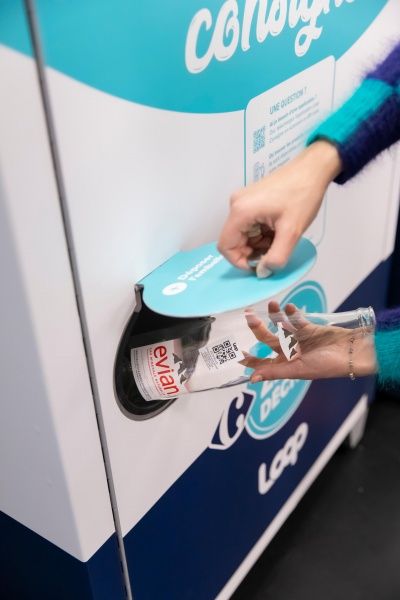
Today, French citizens enjoy a fully functioning, nationwide reuse system offering a wide assortment of everyday consumer products – from wine to shampoo to their favourite spread – in reusable packaging available at their local supermarkets. By pioneering this system, Loop and Carrefour not only validated French consumers’ appetite for reuse but also created the operational conditions that made nationwide deployment possible, in Carrefour and other participating retailers. This interoperable system allows consumers to buy their favorite products nationally in reusable packaging, pay a deposit, use them as usual, and return them without cleaning to any participating retailer. This milestone marks a significant turning point in the global transition from a linear to a circular economy.
Loop’s success in France stands in contrast to widespread deregulation and the rollback of voluntary corporate sustainability commitments in other markets. In France, the right mix of regulation, strong retailer leadership from commercial partners, financial incentives, and a focus on simplicity and convenience has proven that large-scale reuse is not only possible but also operationally sustainable.
France has shown that reuse can work – not as a concept or a pilot, but at full commercial scale. What made this possible wasn’t consumer demand alone – but the alignment of regulation, funding, and supply chain convenience for all actors. It’s a functioning national system. As other countries face growing pressure to move beyond single-use packaging, the lesson is clear: if the conditions are right, reuse can become a mainstream way of doing business – not a fringe solution.
While pilots were conducted in the US, Canada, the UK , Japan, and France, it was Carrefour – the first retail chain worldwide to commit to Loop – that transformed the concept from experimentation to national scale. Carrefour demonstrated that reuse could be seamlessly integrated into mainstream retail.
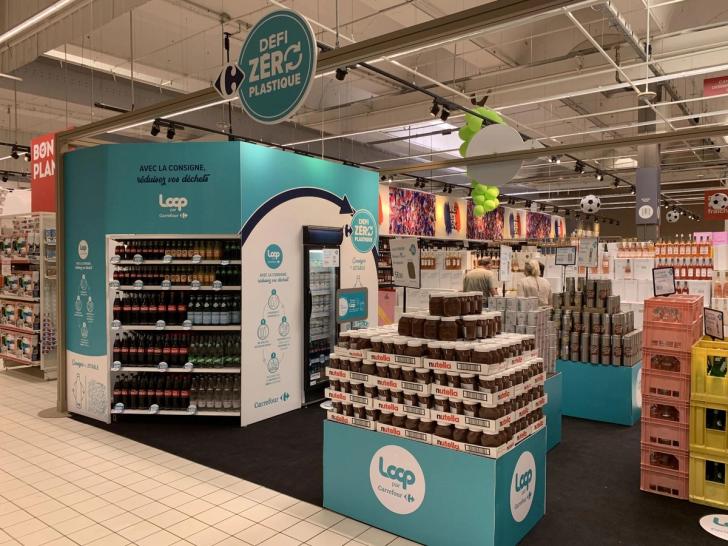
French consumers can access more than 370 food and household products in reusable packaging. Participating brands include Ferrero, Danone, McCormick, Cordier Group, William Peel, Suntory, Coca-Cola, and several leading private-label lines at major French supermarket chains such as Carrefour, Monoprix, and Coopérative U. This achievement was made possible by building the world’s largest multi-stakeholder reuse coalition and collaborating with Circul’R, an international network advancing the circular economy.Reuse is working so well and commercially scaling for a number of key reasons, namely:
- Strong support and long-term partnership with leading retailers: Carrefour invested to make Loop a success, raised awareness among French consumers, provided visibility in stores, and made the offer appealing.
- Clear regulatory mandates: France’s Anti-Waste Law for a Circular Economy (Loi AGEC) requires retailers to incorporate reusable packaging by 2027, creating clear compliance targets.
- Targeted financial support: French producer responsibility organisations allocate a portion of collected fees toward reuse infrastructure, including collection systems that help retailers and brands defray upfront costs.
- Built for simplicity and convenience: Products come prefilled, require no special equipment or processes, and can be returned to any participating location.
Loop’s key retail partner for France, Carine Kraus, Executive Director of Engagement and member of Carrefour’s Executive Committee, puts it as follows: “Thanks to Loop, we’ve proven that it is possible to offer consumers everyday products in reusable packaging – without compromising convenience or the in-store experience. This achievement at industrial scale confirms that the right mix of bold regulation, logistical innovation, and collective commitment is the key to transforming our distribution model for the long term.”
And from a French Governmental perspective, Véronique Louwagie, Minister Delegate for Trade, Crafts, Small and Medium Enterprises, and the Social and Solidarity Economy of France adds: “France has chosen to be a pioneer. With the AGEC law and the commitment of our businesses and regions, we have built one of the most advanced frameworks for reuse in the world. This isn't just a national success; it's a model that inspires, influences, and demonstrates that the transition to a circular economy is possible on a large scale. France will continue to act and commit, alongside all who share this ambition: to build a more sustainable, fairer, and more resilient economy. Because protecting our planet is protecting our common future.”
For the UK then what is needed to enable reuse to thrive? Primarily strong leadership from the UK powers at be in terms of legislation and subsidies. Strong targets and incentives to help with the transition from a linear to a circular supply chain will ensure as has been the case in France, for both retailers and the brands to lean in aggressively to transition to reuse. With this combination of bold legislation and strategic financial support, the UK can follow a proven path to make reuse a mainstream commercial reality on a national scale, rather than just a small sustainability initiative.


Get our weekly digest
resource.co article ai

How will the government and DMOs address the challenges of including glass in DRS while ensuring a level playing field across the UK?
There's no easy solution to include glass in the DRS while maintaining a level playing field. Potential approaches include a phased introduction of glass, potentially with higher deposits to reflect its logistical challenges. The government and DMOs could incentivise innovation in glass packaging design and subsidise dedicated return points for glass-handling. Exemptions for smaller businesses unable to handle glass might also be necessary. Any successful solution will likely blend several approaches. It must address the differing priorities of devolved administrations, balance environmental benefits with logistical and cost implications, and be supported by robust consumer education campaigns emphasizing the importance of glass recycling.