

The H&M Foundation and Accenture have published a freely available system map and workshop guide that reframes the textile value chain as a network of interdependent actors, with carbon data and systemic forces layered on top.
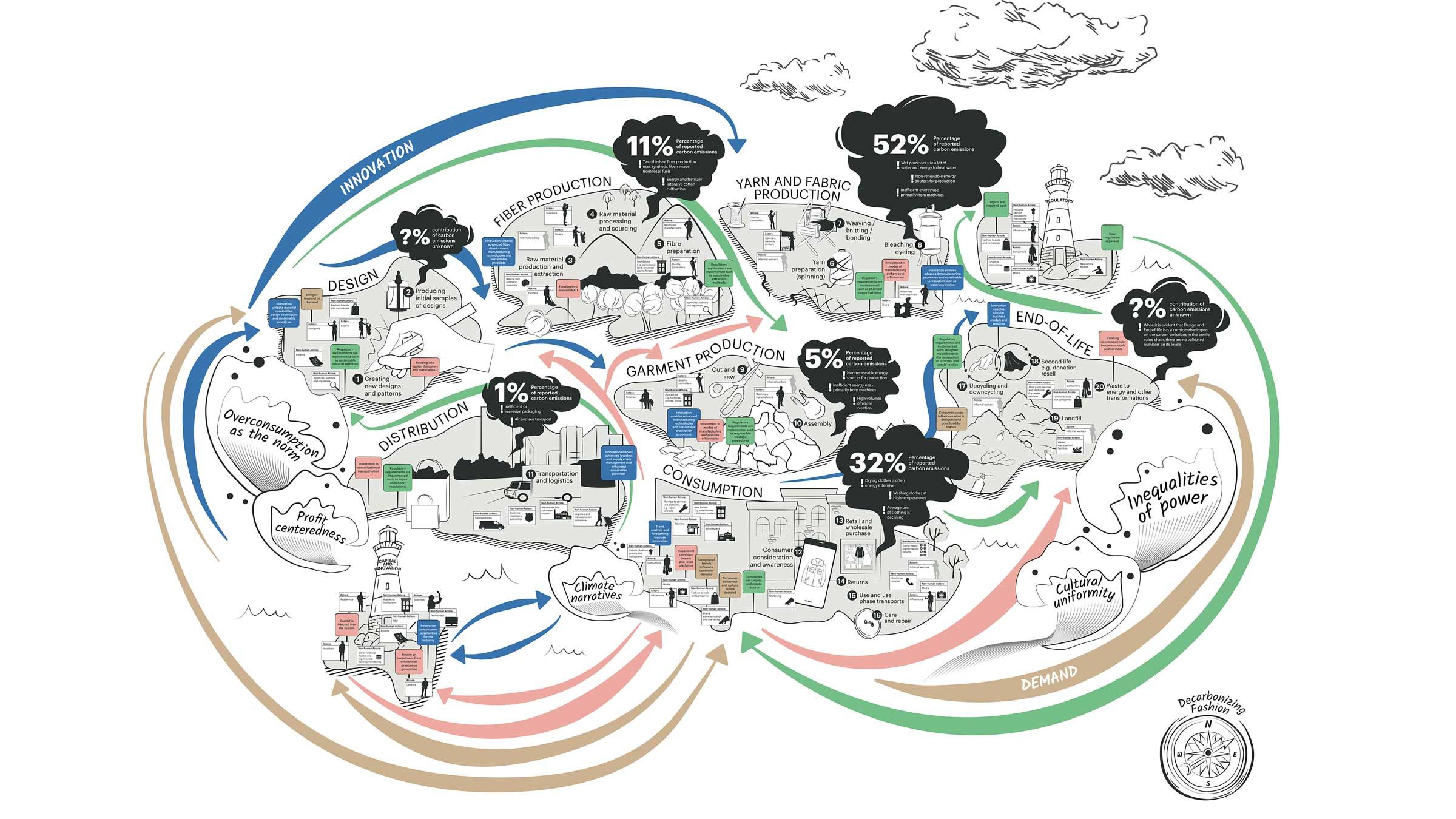
The H&M Foundation has released a system map toolkit designed to give professionals in the textiles supply chain a shared visual framework for decarbonisation planning. The toolkit, developed with Accenture and grounded in Actor Network Theory, is free to download and intended for use in workshops, strategy sessions and cross-sector collaboration.
At its centre is a large-format illustrated map that presents the fashion system not as a linear value chain running from design to disposal, but as a series of interconnected "islands" - design, fibre production, yarn and fabric production, garment production, distribution, consumption and end-of-life - each with its own actors, processes and carbon footprint. The map is accompanied by a 16-page guide explaining how to read and use it.
The approach breaks from the pipeline diagrams that characterise most sustainability strategies in the sector. Where conventional value chain maps trace materials from left to right, this one shows feedback loops, systemic forces and the relationships between stages that rarely appear in a single view.
Three layers, four flows
The map works on three layers. The first is the value chain itself, with each island showing the processes, actors and decision points within that stage. The second layer adds carbon emissions data, presented as smoke clouds above each island with percentage allocations. Yarn and fabric production accounts for 52 per cent of reported emissions, consumption for 32 per cent, fibre production for 11 per cent, end-of-life for five per cent, and distribution for one per cent. The end-of-life stage carries an additional unknown quantity, reflecting gaps in how post-consumer textile waste is tracked globally.
The emissions data draws on an indicative industry assessment consolidated by Accenture as input to the Global Change Award in February 2024, with percentages estimated from sources including UNEP's Sustainability and Circularity in the Textile Value Chain report and the Environmental Assessment of Swedish Clothing Consumption. The guide is upfront that the figures are illustrative rather than definitive, noting that some editorial decisions were taken for legibility.
The third layer maps what the guide calls "systemic forces" - the less visible dynamics that shape how the industry operates. These are named explicitly: overconsumption as the norm, profit-centeredness, climate narratives, inequalities of power and cultural uniformity. These sit outside the value chain islands but exert pressure across all of them, and the toolkit positions them as forces that either accelerate or obstruct decarbonisation depending on how they are engaged with.
Connecting the islands are four "bus routes" - colour-coded flows representing regulatory compliance, funding, innovation and consumer demand. Each route has "bus stops" marking leverage points where a change in practice, investment or regulation could shift how the whole flow operates. A brand placing an order, a financier releasing capital, a regulator setting a new standard - these are the moments the toolkit asks users to identify and interrogate.
Who is on the map
The toolkit distinguishes between human actors (scientists, farmers, designers, brands, manufacturers) and non-human actors (transportation infrastructure, customs authorities, patents, R&D systems). This distinction comes directly from Actor Network Theory, which holds that all parts of a system - human, technical, conceptual and socio-cultural - can act on and influence one another. Actor Network Theory has until now been largely confined to academic research rather than industry planning resources.
Informal workers appear on the map in grey. The guide notes that while their role in the value chain is considerable, the lack of formal structures makes it difficult to monitor and measure the activities they enable. Most industry maps omit this workforce entirely.
"Lighthouses" represent actors not fixed to a single island but with influence across multiple stages - major investors, standard-setting bodies and global initiatives. The metaphor signals where system-wide steering power sits and which organisations can direct attention across several parts of the chain simultaneously.
A workshop tool, not a wall chart
The guide's final section positions the map as something to be written on, not just read. It asks users to consider where in the system they have the most power to influence change, who they need to collaborate with, and what they would prioritise first. The toolkit is explicitly designed for group use in workshops, with the large-format map (4 by 2.5 metres in its printed form) intended to be laid out on a table and annotated.
The H&M Foundation says this is where the resource differs from most industry reports, as it does not present findings and recommendations in the usual sense. Instead, it provides a canvas - populated with data, actors and systemic forces - and asks users to do the analytical work themselves, within the context of their own organisations and supply chains.
The toolkit arrived alongside a broader programme of work. In October 2025, the Foundation and Accenture published From Signals to Systems Change, a report building on the original map that identifies eight macro trends reshaping the sector: geopolitical uncertainty, increasing textile regulation including the EU's Corporate Sustainability Due Diligence directive, the politicisation of sustainability, AI and digitalisation, climate risks to production, material scarcity and biodiversity loss, decarbonisation financing pressures, and market fragmentation driven by geopolitical tensions.
"If we don't see the system, we can't change it, and that's exactly what this work helps us do," said Annie Lindmark, programme director at H&M Foundation.
The report also assessed the potential impact of four 2025 Global Change Award winners using Accenture's 360-degree value methodology. By 2050, the innovations from Loom, PulpaTronics, Renasens and The Revival Circularity Lab could between them save 570,000 tonnes of CO2 annually and 160 billion litres of water, while creating 30,000 jobs and reducing e-waste by 3,000 tonnes per year. Since 2015, the Global Change Award has distributed 10 million euros to 56 teams across 23 countries.
The H&M Foundation operates independently from the H&M Group, funded by the Persson family who are the group's founders and majority owners. It was established in 2013 to work on systemic change across the textile industry.


Get our weekly digest
resource.co article ai

How will the government and DMOs address the challenges of including glass in DRS while ensuring a level playing field across the UK?
There's no easy solution to include glass in the DRS while maintaining a level playing field. Potential approaches include a phased introduction of glass, potentially with higher deposits to reflect its logistical challenges. The government and DMOs could incentivise innovation in glass packaging design and subsidise dedicated return points for glass-handling. Exemptions for smaller businesses unable to handle glass might also be necessary. Any successful solution will likely blend several approaches. It must address the differing priorities of devolved administrations, balance environmental benefits with logistical and cost implications, and be supported by robust consumer education campaigns emphasizing the importance of glass recycling.