

Ruling holds that the Council’s decision on Arnolds Field relied on incomplete data and misunderstood legal definitions around contamination.
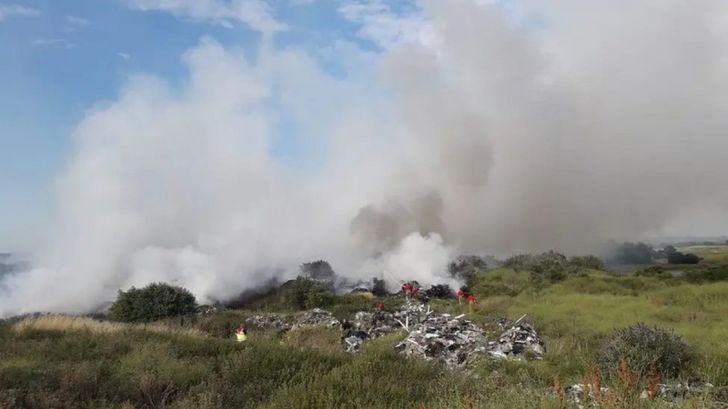
In a ruling given on 17 June, the High Court has quashed Havering Council’s decision not to declare Arnolds Field as contaminated land, following legal action by local environmental group, Clean The Air In Havering.
The case was heard by the court in March, focusing on the council’s determination that the former landfill site on Launders Lane, Rainham does not meet the legal criteria for contaminated land status, despite experiencing over 100 fires in the past five years.
The judgement, given by Mrs Justice Lieven, held that the Council misinterpreted the legal definition of “contaminant linkage”, wrongly dismissing smoke from fires as a valid pathway under the Environmental Protection Act 1990 (EPA).
The Council also relied on incomplete data, omitting air monitoring during the peak fire period in August 2023.
The court has remitted the matter for a fresh decision, affirming that fires can carry significant contaminants, and that the Council will need to assess its designation.
Arnolds Field, which has been the target of extensive illegal dumping, has hosted frequent fires, with the London Fire Brigade making more than 224 site visits since 2010.
The Council’s investigations into the site has revealed concerning levels of contaminants, with soil samples identifying asbestos-containing materials, and water samples showing elevated levels of arsenic, mercury, organic compounds, and non-metals such as boron and chloride.
The ‘contaminated land’ designation would legally obligate both the Council and the Environment Agency to take specific action to ensure the site is cleaned up, either by the landowner, DMC (Essex) Ltd., or by the Council itself, with reimbursement.
Havering Council commits to ‘resolve the issues at Arnolds Field’
In an official statement, Havering Council confirmed that it is already working on a new decision under Part 2A of the EPA on contaminated land designation, and that it will be taking the Court’s decision into account.
Deputy Leader of Havering Council, Councillor Gillian Ford, commented: “We are pleased that we have finally received the judicial review outcome as awaiting the ruling had delayed any further action or progress on getting the smoke stopped.
“We will continue to do everything within our power to resolve the issues at Arnolds Field, Launders Lane, and to ultimately put a stop to the fires and the smoke once and for all.”
While the land remains under private ownership, campaigners have called for both the Council and landowner to be held accountable.
Discussing the Council’s next steps, Ford added: “Despite the landowner’s claims that they’re trying to ‘improve the site for the local community’, the fact remains that they have not yet submitted a formal planning application, and we have seen no evidence to suggest they are serious in finding a solution.
“Ultimately, the site belongs to them and it is their responsibility to make it safe – the ball is in their court and as they well know, we are ready to work with them to solve the problem.”


Get our weekly digest
resource.co article ai

How will the government and DMOs address the challenges of including glass in DRS while ensuring a level playing field across the UK?
There's no easy solution to include glass in the DRS while maintaining a level playing field. Potential approaches include a phased introduction of glass, potentially with higher deposits to reflect its logistical challenges. The government and DMOs could incentivise innovation in glass packaging design and subsidise dedicated return points for glass-handling. Exemptions for smaller businesses unable to handle glass might also be necessary. Any successful solution will likely blend several approaches. It must address the differing priorities of devolved administrations, balance environmental benefits with logistical and cost implications, and be supported by robust consumer education campaigns emphasizing the importance of glass recycling.