

University of Glasgow research demonstrates manufacturing process for zinc-based circuit boards that can either degrade through soil composting or be dissolved to recover components, with life cycle assessment showing substantial environmental benefits over conventional electronics.
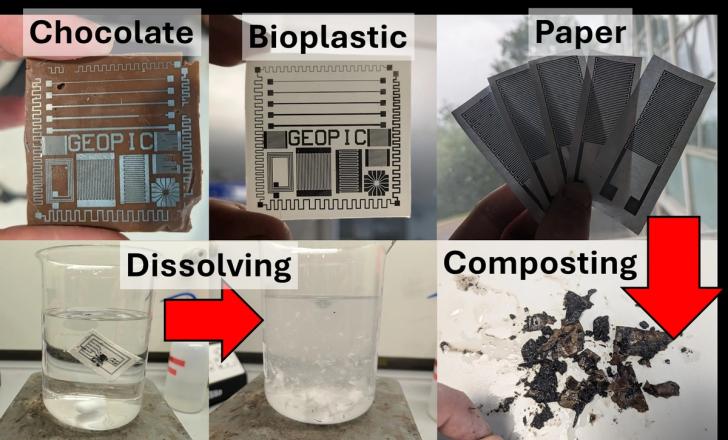
Circuit boards where more than 99 per cent of materials can degrade into low-toxicity products have been developed by researchers at the University of Glasgow, offering a potential route to address the growing challenge of electronic waste from disposable devices.
The research, published in the journal Communications Materials, demonstrates a "growth-and-transfer" manufacturing process that electroplates zinc tracks onto biodegradable substrates including paper, bioplastics and chitosan. The resulting circuits achieve performance comparable to conventional copper-based boards while enabling either soil composting or controlled dissolution at end of life.
The work comes as global e-waste reached 62 million tonnes in 2024. Circuit boards present a particular recycling challenge – less than 17 per cent are recycled in the European Union, with the fibreglass-resin substrates and brominated fire retardants used in conventional boards making up around 70 per cent of their weight yet proving impossible to recycle.
"The work demonstrates a major step toward circular electronics, where devices are designed from the outset for reuse, recycling, or safe degradation," said Dr Jonathon Harwell of the University of Glasgow's James Watt School of Engineering, the paper's first author. "Discarded devices already generate tens of millions of tonnes of waste annually, so our research could have far-reaching impacts for consumer electronics, internet-of-things devices and disposable sensors in the future."
Zinc as conductor
The research team uses zinc rather than copper to create conductive tracks just five microns wide. The process works by electroplating zinc onto a temporary aluminium carrier, which is then transferred to a biodegradable base material. According to the paper, zinc has an environmental footprint approximately 100 times lower than silver and offers conductivity of 1.7 × 10⁷ S/m, close to bulk metal performance.
The team reports achieving sheet resistance as low as 3 mΩ/sq, with samples showing stable performance after more than a year of storage under ambient conditions. A life cycle assessment comparing the zinc-based approach against conventional FR4-copper boards found a 79 per cent reduction in lifecycle greenhouse gas emissions and approximately 90 per cent reduction in use of non-renewable resources.
The process is compatible with multiple substrate materials. Professor Jeff Kettle, the paper's corresponding author, said: "One key aspect of our work is that almost any substrate material can be used, ranging from paper and bioplastics for more realistic applications, to chocolate for tasty but probably not very practical demonstrations."
End-of-life pathways
The research identifies two distinct routes for managing these circuit boards at end of life. For applications where component recovery is desirable, the boards can be immersed in dilute acetic acid solution (5 per cent concentration) with stirring for approximately 30 minutes. This dissolves the zinc tracks and chitosan binder, allowing microcontrollers, LEDs and resistors to float free for filtering and reuse. The researchers report that 100 per cent of tested components remained functional after recovery.
For single-use applications where component recovery is impractical, the assemblies can degrade through soil composting. Under conditions matching industrial composting (65°C, 85 per cent relative humidity), unencapsulated zinc on a PHBV substrate degrades within approximately 11 days. The zinc forms naturally occurring compounds including zinc oxide, zinc carbonate and zinc phosphate depending on soil composition.
The paper notes that permissible limits for zinc in compost range from 150 to 800 ppm depending on legislation. The researchers calculated that a circuit board degraded in 100g of soil would reach end concentrations of 140 ppm zinc, within WHO and EU composting limits. However, they acknowledge that biodegradability testing for zinc in soil environments remains immature and recommend additional studies on degradation pathways.
"From an operational and circular economy point of view, and if this was to be commercialised, I'd prefer zinc to be controllably degraded in a laboratory as there is the potential to recover this and reuse it in new circuits," Professor Kettle told Resource.
Emerging field
The research forms part of the University of Glasgow-led Responsible Electronics and Circular Technology Centre (REACT), backed by more than £6 million from UKRI. The centre, established in 2024, is one of five Green Economy Centres investigating ways to make industries more sustainable, with researchers examining complementary technologies including scalable WEEE processing and recycling.
Other UK initiatives are pursuing alternative approaches to the same challenge. The University of Portsmouth and Jiva Materials announced a partnership in 2024 to develop Soluboard, a laminate that can be dissolved using hot water to enable recovery of natural fibres, copper and electronic components. That approach retains copper as the conductor while replacing the fibreglass substrate with organic materials.
The Glasgow team is now exploring applications including mouldable electronics and biosensing. The paper identifies intended applications as smart packaging, IoT devices, disposable test kits and environmental sensors, where the priority is minimising environmental impact rather than long-term durability.


Get our weekly digest
resource.co article ai

How will the government and DMOs address the challenges of including glass in DRS while ensuring a level playing field across the UK?
There's no easy solution to include glass in the DRS while maintaining a level playing field. Potential approaches include a phased introduction of glass, potentially with higher deposits to reflect its logistical challenges. The government and DMOs could incentivise innovation in glass packaging design and subsidise dedicated return points for glass-handling. Exemptions for smaller businesses unable to handle glass might also be necessary. Any successful solution will likely blend several approaches. It must address the differing priorities of devolved administrations, balance environmental benefits with logistical and cost implications, and be supported by robust consumer education campaigns emphasizing the importance of glass recycling.