

The trimaran that launched a thousand circular economy presentations is getting the treatment itself, courtesy of an EPFL spin-off with industrial-scale ambitions.
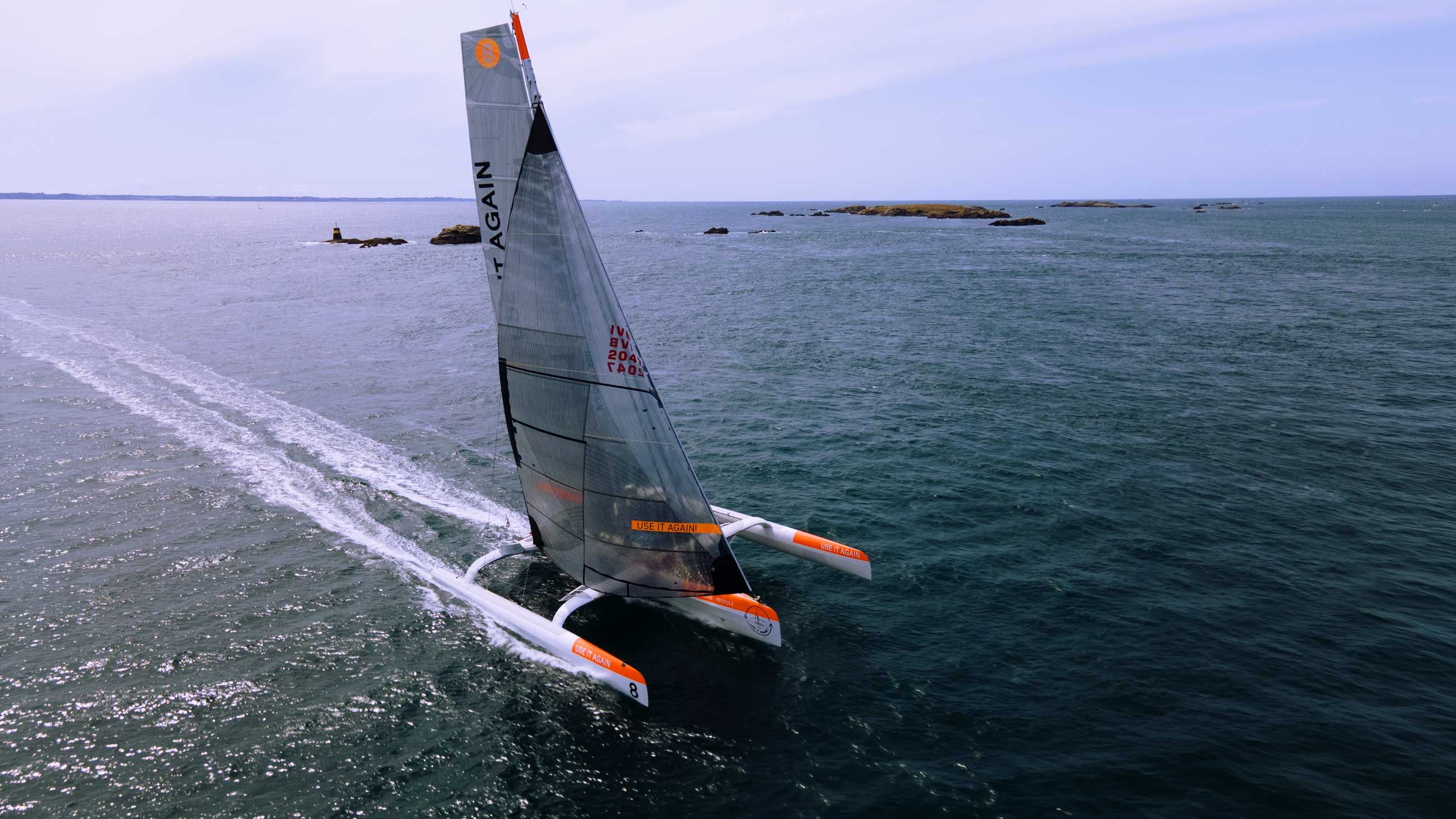
The 75-foot trimaran that Dame Ellen MacArthur sailed around the world in 71 days, 14 hours and 18 minutes in 2005 has had a less celebrated second career than its former skipper. After breaking the solo circumnavigation record, MacArthur went on to reshape how industry thinks about materials. The boat was laid up in the port of Brest.
In 2015, French skipper and ocean advocate Romain Pilliard acquired the vessel and set about renovating it on the very principles its former captain had gone on to champion. He retained the original hull, mast and boom, sourced reconditioned sails, solar panels and desalination units from other vessels, and had solar panel fixtures fabricated from discarded automotive airbag fabric. Renamed Use It Again!, the trimaran has since completed a westbound circumnavigation and collaborated with the University of Paris-Sorbonne on underwater sound mapping of whale and dolphin communications.
Now the boat has become a test case for a technology that could, if it works at scale, address one of the circular economy’s more persistent material problems: what to do with thermoset glass fibre composites at end of life.
Restoring what recycling degrades
Glass fibre reinforced polymers are engineered to last. The resin matrices that bind them are designed to withstand decades of saltwater, UV exposure and mechanical stress, which is exactly why they end up in boat hulls, wind turbine blades and automotive panels. It is also why, at end of life, they are so difficult to deal with. Europe produces an estimated 683,000 tonnes of composite waste per year, and more than 40,000 tonnes of that goes straight to landfill. The rest is largely incinerated or shredded into low-value fillers for construction, permanently losing the structural properties that made the material worth manufacturing in the first place. Processes exist to extract the fibres - pyrolysis, solvolysis, pressolysis - but they tend to damage what they recover.
Verretex, a cleantech company spun out of EPFL and IMD in Saint-Sulpice, western Switzerland, is positioned at the step after extraction. Working with a Spain-based recycling partner that handles the initial breakdown, the company takes already-extracted glass fibres and applies a proprietary treatment to clean and repair the fibre surfaces at a microscopic level before re-adding the protective sizing coating. The output is engineered into wetlaid nonwovens with full multi-resin compatibility - meaning manufacturers can use them as drop-in replacements in existing workflows with epoxy, polyester and vinyl ester matrices.
“The end-of-life reality for marine composites demands tangible action,” said Mitchell Anderson, CEO of Verretex. “Regenerating the fibreglass from a legendary vessel raises awareness that recovered fibres can be fully restored and used again. We are proving that end-of-life composites are a high-value resource, not permanent waste.”
That claim has some independent backing. Testing at EPFL’s composite specialist laboratory found that tensile and flexural strength values for Verretex-treated fibres were comparable to those of virgin glass fibres, with tests performed on finished composite parts under real application conditions. Separate dry-tensile testing at a German research institute confirmed that the nonwoven material’s properties aligned with established industrial benchmarks.
During routine renovation of Use It Again!, roughly one kilogram of glass fibre composite was removed from the still-operational vessel. That material is being processed by Verretex and the output will go to ID Geneve, the B Corp-certified Geneva watchmaker, for use in limited-edition watch faces. The timepiece is due to be unveiled at Climate Week New York in September 2026. Pilliard plans to wear one when he races in the Route du Rhum on 1 November.
“My trimaran Use It Again shows another route is possible for the circular economy,” said Pilliard. “Having composite pieces of my boat upcycled into a luxury watch is very special, and it makes for an exciting project built all together with Verretex and ID Geneve watches.”
From one kilogram to 100 kilotonnes
One kilogram is a symbolic quantity, and Verretex is open about that. Applying reclaimed marine fibre to luxury Swiss watchmaking serves a specific purpose: if recovered composites can meet the tolerances required for precision watch components, the case for using them in less exacting industrial applications is harder to dismiss.
Verretex currently operates at a scale of tonnes per year. It plans to reach kilotonne-scale production by 2028 and is targeting 100 kilotonne capacity within the decade, with target markets in wind energy, automotive, marine, sporting goods and construction. The company raised CHF 1.2 million in a funding round combining dilutive and non-dilutive capital to strengthen its industrial operations. A strategic collaboration with Fiberloop, a Swedish manufacturer of composite recycling machinery, is intended to secure feedstock supply as production scales. A pilot with wind turbine manufacturer Ryse Energy confirmed that Verretex’s recycled textile met the manufacturer’s performance standards with no modifications to production equipment required.
There is a neat circularity to the trimaran’s story that goes beyond the material itself. MacArthur sailed it around the world, then spent the next 15 years building the intellectual case for keeping materials in use. Pilliard acquired the vessel, rebuilt it from reconditioned parts, and is now handing its waste composites to a company trying to prove that glass fibre need not be a single-use material. Whether Verretex can close the gap between a one-kilogram demonstration and the hundreds of thousands of tonnes Europe discards each year is a different question. But the boat, at least, has come full circle.


Get our weekly digest
resource.co article ai

How will the government and DMOs address the challenges of including glass in DRS while ensuring a level playing field across the UK?
There's no easy solution to include glass in the DRS while maintaining a level playing field. Potential approaches include a phased introduction of glass, potentially with higher deposits to reflect its logistical challenges. The government and DMOs could incentivise innovation in glass packaging design and subsidise dedicated return points for glass-handling. Exemptions for smaller businesses unable to handle glass might also be necessary. Any successful solution will likely blend several approaches. It must address the differing priorities of devolved administrations, balance environmental benefits with logistical and cost implications, and be supported by robust consumer education campaigns emphasizing the importance of glass recycling.