

Joint Research Centre blueprint for EU-wide packaging labels reveals tension between consumer preferences for colour and industry demands for pictogram-only simplicity.
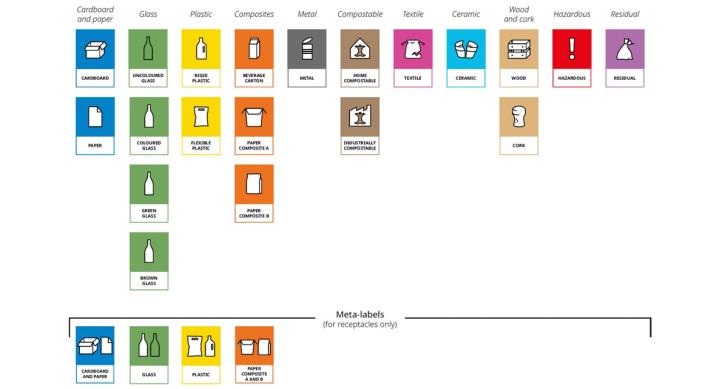
The European Commission's Joint Research Centre (JRC) has published its technical proposal for harmonised waste sorting labels across the EU, recommending a system of material-based pictograms that would appear on both packaging and bins to help consumers dispose of items in the correct waste stream.
The proposal, which will inform implementation rules of the Packaging and Packaging Waste Regulation (PPWR), draws on behavioural research with more than 25,000 EU citizens. Through testing, the JRC found that labels improved sorting accuracy by 38 per cent compared to no labels.
However, its recommendations on colour and text have previously drawn a pushback from industry groups concerned about costs and market fragmentation.
The PPWR, which came into force last year and will apply from this August, aims to tackle the 84 million tonnes of packaging waste generated across the EU (2022 figures) – equivalent to 187 kg per person – and the wide variation in recycling rates between Member States, which range from 40 to 80 per cent.
How the matching system works
The proposal sets out around 20 distinct material categories, covering everything from paper and cardboard to coloured glass variants, rigid and flexible plastics, beverage cartons, and other composites. The core idea is that consumers see a pictogram on their packaging and look for the same pictogram on their bin, avoiding the need to interpret what the label says.
In behavioural experiments across 11 Member States, 82 per cent of participants reported having sufficient information to sort correctly when using the proposed labels. Recognition rates varied by material: paper and cardboard achieved 96 per cent, uncoloured glass 91 per cent, metal 89 per cent and rigid plastic 85 per cent. Flexible plastic proved more challenging at 70 per cent, and wood reached just 53 per cent.
The research also found that colour matters. Three quarters of citizens preferred coloured labels, and colour contributed more to sorting accuracy than text did. As a result, the JRC therefore recommends mandatory colour on bin labels, with a suggested scheme of blue for paper, yellow for plastics, green for glass, grey or black for metal, and brown for compostable materials.
Notably, though, on the packaging itself recognising industry pushback, the colour suggests the colour could be optional.
In July 2025, more than 60 organisations – including FoodDrinkEurope, AIM, Cosmetics Europe, DIGITALEUROPE and EuroCommerce – issued a joint statement opposing mandatory colour and text on packaging labels.
Their argument centres on practicality. Colour printing increases production costs and environmental impact. Mandatory text would require different label versions for different language markets – the opposite of the harmonisation the regulation is meant to achieve. Branding constraints also make coloured labels difficult for many products. Industry groups want pictograms as the primary element, with colour and text as optional.
The JRC report recognises this tension but stops short of resolving it. The proposal says that text is encouraged but not mandatory, with pictograms intended as the primary matching element. Previous stakeholder consultations gathered input from more than 300 organisations across the waste management and packaging sectors, revealing competing priorities that the final implementing acts will need to reconcile.
Compostables and other complications
Some packaging types require special treatment. Multi-component items can carry multiple labels to indicate different materials. Compostable packaging must display pictograms alongside either a house icon (for home compostable) or factory icon (for industrial composting), plus mandatory "DO NOT THROW IN NATURE" text – intended to prevent consumers from discarding compostable items in the natural environment.
The JRC proposal also suggests that QR codes could provide country-specific guidance and accessibility features, while packaging in deposit return schemes would be exempt from waste sorting label requirements.
However, the JRC's recommendations are advisory. The Commission's Directorate-General for Environment will use them to draft implementing acts, which must be adopted by August 2026 to become binding. Many details – including whether colour and text should be mandatory or optional – are flagged in the report as matters for negotiation during that process.
The JRC report also notes some inherent limitations. The system is material-based, but recyclability often depends on factors like contamination, coatings and size that labels cannot capture.
The EU's labelling deliberations are being watched closely from this side of the Channel. Defra had planned to introduce mandatory recycling labels using the "Recycle Now" mark by 2026 but has pushed this back to August 2028, reportedly to see how the EU system lands before committing to a UK approach that might need to work alongside it.
Previous JRC analysis concluded that the costs of harmonised labelling would be outweighed by savings in waste management and environmental externalities, provided the system achieves at least a two per cent increase in capture rates and 12 per cent improvement in purity. Even a more modest one per cent capture rate gain would deliver positive net social benefits.
National and regional labels across the EU must be withdrawn by August 2028, or 24 months after implementing acts are adopted, whichever is later. From 2030, all packaging on the EU market must meet design-for-recyclability standards, graded A to C based on how effectively the packaging can be recycled.
Inevitably, for businesses placing packaging onto both the EU and UK markets, there will be an ongoing need to track two evolving regimes – and the extent to which they converge or diverge.


Get our weekly digest
resource.co article ai

How will the government and DMOs address the challenges of including glass in DRS while ensuring a level playing field across the UK?
There's no easy solution to include glass in the DRS while maintaining a level playing field. Potential approaches include a phased introduction of glass, potentially with higher deposits to reflect its logistical challenges. The government and DMOs could incentivise innovation in glass packaging design and subsidise dedicated return points for glass-handling. Exemptions for smaller businesses unable to handle glass might also be necessary. Any successful solution will likely blend several approaches. It must address the differing priorities of devolved administrations, balance environmental benefits with logistical and cost implications, and be supported by robust consumer education campaigns emphasizing the importance of glass recycling.