

Mhairi Black, MP for Paisley and Renfrewshire South, has officially opened Enva’s £1.5 million Ash Recycling Plant in Paisley, Scotland.
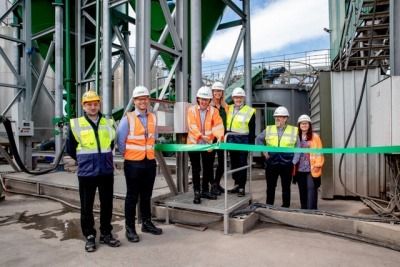
Annually, the facility will be able to treat up to 20,000 tonnes of fly ash from biomass and Energy from Waste (EfW) facilities, Enva has said. Ash, which is usually sent for disposal in hazardous landfill sites, will be washed to remove contaminants and then combined with other materials – making it a ‘sustainable, concrete product’.
Enva has partnered with Anglo Scottish Concrete Holdings (ASCH), a concrete and aggregate supply company, to achieve the ash recycling process. Together, they will aim ‘to replace quarried aggregates with recovered materials’.
The Scottish Environment Protection Agency recently upgraded the classification of recycled aggregate from a ‘deregulated material’ to full ‘end of waste’ status. Enva say this amendment will help to ‘market and position the product alongside its virgin counterparts’.
Local construction companies will be working alongside the facility, which will supply a new sand replacement product for several applications. This will support a reduced carbon footprint from quarried materials and transportation.
Mhairi Black, MP for Paisley and Renfrewshire South, said: “Enva’s ash recycling plant showcases how Scottish businesses are innovating and driving the development of the circular economy. In addition to the clear environmental benefits, investment in these sustainable technologies creates jobs and helps to support local economies. This is only the start of the journey and I look forward to seeing how this exciting facility develops over the coming months and years.”
Tom Walsh, Enva’s CEO, added: “The environmental benefits of recycling fly ash are compelling. Every tonne of recycled aggregate produced by this plant reduces demand for quarried materials by the same amount and working with ASCH can offset 200-300kg of virgin material in every tonne of concrete manufactured.
“In addition to the clear benefits of reducing waste to landfill the use of this recycled product enables construction companies to utilise secondary resources with comparable characteristics and qualities to those of virgin materials.
“Providing a solution that manages waste near to its point of production also has clear benefits. Reducing the associated haulage has saved an estimated 950,000kg of CO2.”


Get our weekly digest
resource.co article ai

How will the government and DMOs address the challenges of including glass in DRS while ensuring a level playing field across the UK?
There's no easy solution to include glass in the DRS while maintaining a level playing field. Potential approaches include a phased introduction of glass, potentially with higher deposits to reflect its logistical challenges. The government and DMOs could incentivise innovation in glass packaging design and subsidise dedicated return points for glass-handling. Exemptions for smaller businesses unable to handle glass might also be necessary. Any successful solution will likely blend several approaches. It must address the differing priorities of devolved administrations, balance environmental benefits with logistical and cost implications, and be supported by robust consumer education campaigns emphasizing the importance of glass recycling.