

A new action plan commits £45 million to Environment Agency enforcement and sets out regulatory reforms that will change how waste carriers, brokers and permit holders operate across England.
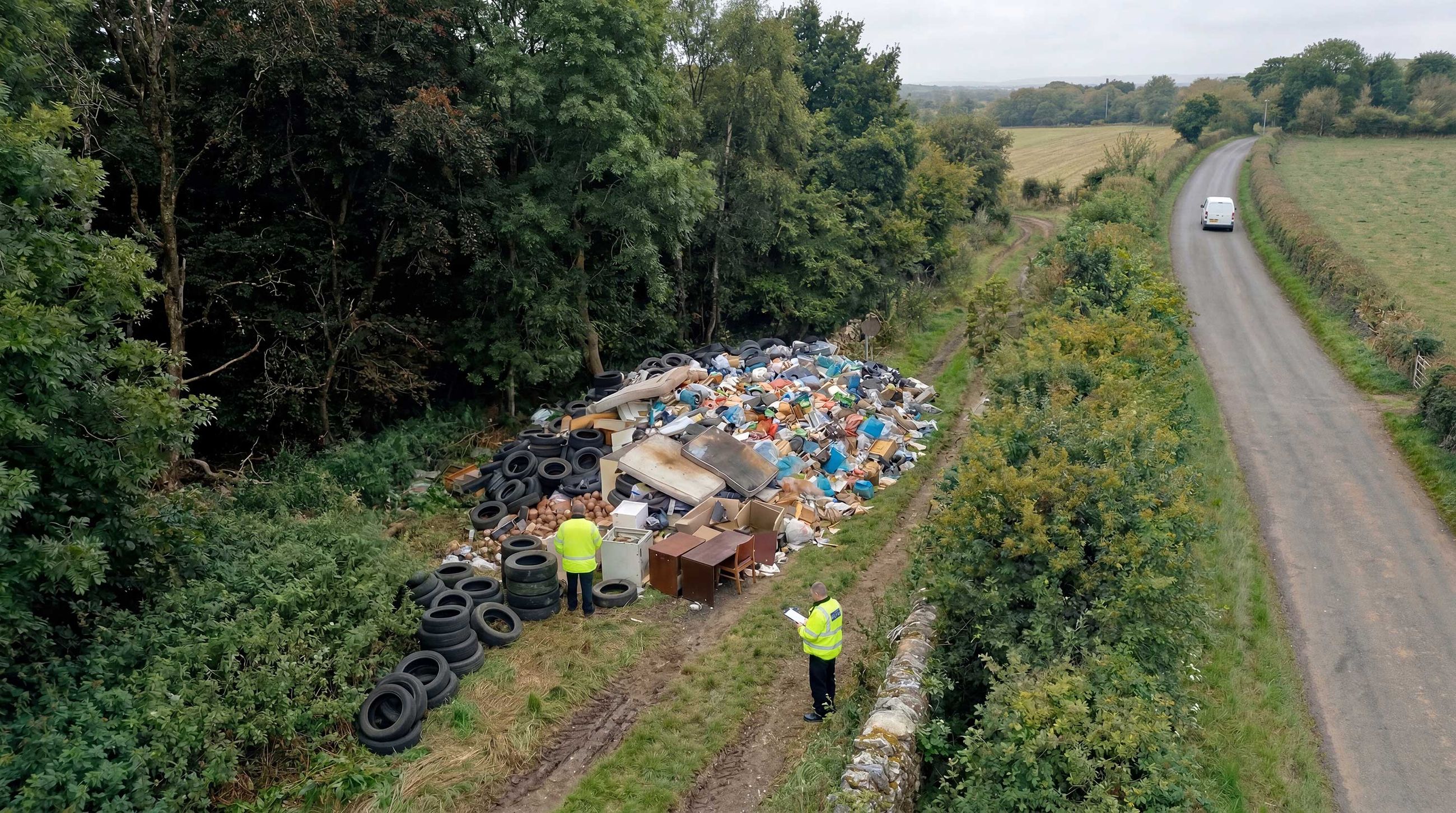
Fly-tippers in England could be ordered to complete up to 20 hours of unpaid work clearing streets and parks under a Waste Crime Action Plan published by Defra and the Environment Agency today (19 March).
The plan, structured around three objectives of prevention, enforcement and remediation, includes an additional £45 million in enforcement funding for the Environment Agency over the next three financial years, which comes on top of a £5.6 million increase already announced for 2025/26.
"Waste criminals have been damaging our communities, countryside, environment and economy for too long," said Environment Secretary Emma Reynolds. "This Action Plan sends a clear message: dump illegally and you will face the full consequences."
Waste crime is estimated to cost the English economy £1 billion a year, according to the Environmental Services Association, with 20 per cent of all waste managed illegally. In addition, there is lost income for the public purse, with HMRC claiming that as much as £150 million was lost through Landfill Tax evasion in 2023-24 alone.
Regulatory reforms
The Action Plan brings together several regulatory workstreams that will change day-to-day obligations for waste operators. The most significant is the carriers, brokers and dealers (CBD) reform, which will replace the current light-touch registration system with full environmental permits under the Environmental Permitting (England and Wales) Regulations 2016. Although not a new announcement - Defra consulted on the reform in January 2022 and published its policy paper in September 2025 - its inclusion in the Action Plan confirms it remains a priority, though no go-live date has been set.
Under the new system, businesses will be reclassified as "waste transporters" (those physically moving waste) or "waste controllers" (those arranging collection, classification and disposal), or both. Each will need a permit from one of four risk-based tiers, to demonstrate technical competence with renewal required every three years. According to the proposal, operating without a permit will in future carry penalties of up to five years' imprisonment.
Waste permit exemptions were designed as light-touch regulation for small-scale, low-risk activities, but the Action Plan acknowledges they have been exploited. The second reform will remove three exemptions where regulators have identified particular problems. U16 (use of depolluted end-of-life vehicles for parts) has been linked to high levels of illegal activity. T8 (mechanical treatment of end-of-life tyres) is being removed because of fire risk from tyre storage and evidence that exemption limits are being exceeded by significant amounts. T9 (recovery of scrap metal) is going for similar fire and drainage concerns, with the government saying removal will "level up the metal recycling sector" by applying equal standards to all operators.
Conditions are being tightened on seven others - U1, T4, T6, T12, D7, S1 and S2 - largely because operators have registered multiple exemptions at single sites, intensifying operations beyond what the exemptions were designed to cover. Operators currently relying on removed exemptions will need to apply for an environmental permit or cease activity.
Exemptions will also no longer be allowed at sites that already hold an environmental permit. At present, an operator can register exemptions alongside a permit, allowing them to handle waste streams or volumes that fall outside their permitted activity with less regulatory oversight. The Action Plan describes this as a loophole.
Separately, the Environment Agency will gain the power to amend exemption conditions without waiting for new legislation, through changes to the Environmental Permitting Regulations 2016 planned for later in 2026.
The third strand is digital waste tracking, which becomes available for all licensed and permitted waste receiving sites from April 2026 and mandatory from October 2026. The system will replace paper-based waste transfer notes with a single UK-wide digital platform, giving regulators near real-time visibility of waste movements across the supply chain.
New enforcement tech
On enforcement, Defra and the Home Office intend to extend powers under the Police and Criminal Evidence Act 1984 (PACE) to Environment Agency officers. These would allow officers to search premises, seize assets and arrest individuals suspected of waste crime without a warrant - powers first signalled by Defra earlier this month. The Action Plan uses the word "explore" in relation to PACE, suggesting this commitment is at an earlier stage than the other reforms. The government extended PACE powers to food crime officers through a statutory instrument in 2025, which provides a precedent for how EA officers might gain similar powers.
The Environment Agency has published a separate 10 Point Plan setting out how it will act earlier against illegal activity, including greater use of restriction notices that can shut down an illegal waste operation immediately. Operators who ignore a restriction notice face up to 51 weeks in prison.
Philip Duffy, chief executive of the Environment Agency, said: "We will act earlier, faster and smarter by shutting down illegal sites before they become established, using our powers decisively to strip rogue operators of their permits, and working with police, HMRC and councils to go after criminal assets."
The Agency is establishing a new Operational Waste Intelligence and Analysis Unit that will bring together satellite imagery, drone surveillance, financial data and criminal intelligence for the first time.
The EA now has 33 trained drone pilots and is fitting Light Detection and Ranging (LiDAR) technology to its fleet, which will allow officers to measure the volume of waste at a site and detect changes over time. The resulting data can be used as evidence in court.
Waste carriers need both an HGV operator licence and registration on the waste carrier register, but until now there has been no routine way to check one against the other. The EA has developed a screening tool that cross-references the two, flagging businesses where the paperwork does not match. A trial in East Anglia used the tool to identify a waste company that had secretly relocated its HGV operations to a new site to avoid enforcement.
The Joint Unit for Waste Crime has been expanded to 20 specialist officers, including former police officers. Since July 2024, the EA's Economic Crime Unit has progressed 26 money laundering investigations and obtained 42 confiscation orders. Defra, the Home Office and the National Police Chiefs' Council will undertake a full review of the multi-agency response to waste crime, from local to national level.
The plan also targets the financial side of waste crime. HMRC is expanding its tax-check rules to cover waste operators, and is looking at linking permit renewals to tax compliance - meaning an operator with an unpaid tax bill could struggle to renew. New data-sharing agreements between the EA and HMRC have already opened up areas that were previously invisible to regulators, including Roll On Roll Off shipments at ports.
Council powers
For local authorities, the plan brings a mix of new powers and new duties. Defra will consult on giving councils the power to issue conditional cautions for fly-tipping under Section 33 of the Environmental Protection Act 1990. These pre-court sanctions could require offenders to complete up to 20 hours of unpaid work and pay back the cost of clearing illegally dumped waste. If an offender admits to the crime and complies with conditions, they would avoid prosecution.
Separately, Defra and the Department for Transport will give courts the power to impose penalty points on driving licences for fly-tipping offences. Repeat offenders could face disqualification.
Two pieces of statutory guidance were laid in Parliament on 25 February and take effect from 6 April 2026: updated Guidance on Litter Enforcement Powers, which is now statutory rather than advisory, meaning councils have a legal duty to follow it; and an updated Code of Practice on Litter and Refuse, the first revision since 2006. Local authorities spend around £1 billion a year on cleaning up litter, according to government figures cited in the Action Plan.
The EA will also publicly name illegal waste operators for the first time, and Defra will work with local authorities to extend naming and shaming of fly-tippers in parts of the country where councils already use this approach.
Clearing the worst sites and the scoring framework
The government has committed to clearing some of the worst illegal waste sites in England, with on-site feasibility assessments beginning immediately at three locations: Alan Ramsbottom Way in Hyndburn (10,000 tonnes), Worthing Road in Sheffield (20,000 tonnes) and Bolton House Road in Wigan (18,000 tonnes). The three sites hold a combined 48,000 tonnes of illegally deposited waste.
The sites were selected using a scoring framework published in the Action Plan's Annex., which has been developed with other government departments to identify sites where clearance would bring the greatest benefit. Sites are assessed against three equally weighted categories: operational factors, environmental risk and community impact.
Operational factors include the tonnage of waste present, whether it is hazardous, how long the site has been active, the likelihood of recovering costs from the polluter and any specific challenges identified by EA experts. Environmental risk covers proximity to protected natural areas and watercourses (within 250 metres), the likelihood of harm to protected species and whether removing waste would benefit or damage the local environment. Community impact assesses the level of public concern reported to the EA, the number of households within 500 metres, and proximity to public amenities such as schools and parks.
Each factor is scored and the totals are cumulative. One notable feature of the framework is a negative score of up to minus two for sites where there is a realistic prospect of recovering costs from the polluter, as the government is prioritising sites where the criminals have disappeared and left the community to deal with the consequences.
Defra acknowledges limitations in the data. Some environmental impacts can only be assessed through site visits. Household estimates rely on averages that may not capture local variation. Proximity scoring may favour urban areas with higher housing density. Some sites have missing data points and are treated as unscored, creating a risk that they are underrepresented in the rankings.
Government will wait for the outcome of feasibility assessments before committing to clear specific sites. These assessments will consider access, logistics, environmental risk from the clearance operation itself and whether clearing a site could benefit waste criminals by freeing up land for further dumping.
To help local authorities with the financial burden, the government will develop a Landfill Tax rebate scheme for councils clearing high-risk illegal waste sites. The Action Plan acknowledges that Landfill Tax has been a barrier to clearance. Defra will also work with the insurance industry to explore models that would allow farmers, businesses and landowners to be covered for the cost of clearing waste dumped on their land - the current position is that landowners are liable for clean-up costs regardless of their involvement.
The plan follows pressure from the House of Lords Environment and Climate Change Committee, which in October 2025 described the waste crime enforcement system as broken and called for an independent review. The government's response in December 2025 did not commit to the review, but publication of the Action Plan lays the foundation for addressing many of the concerns raised.


Get our weekly digest
resource.co article ai

How will the government and DMOs address the challenges of including glass in DRS while ensuring a level playing field across the UK?
There's no easy solution to include glass in the DRS while maintaining a level playing field. Potential approaches include a phased introduction of glass, potentially with higher deposits to reflect its logistical challenges. The government and DMOs could incentivise innovation in glass packaging design and subsidise dedicated return points for glass-handling. Exemptions for smaller businesses unable to handle glass might also be necessary. Any successful solution will likely blend several approaches. It must address the differing priorities of devolved administrations, balance environmental benefits with logistical and cost implications, and be supported by robust consumer education campaigns emphasizing the importance of glass recycling.