

Chemical company INEOS Olefins and Polymers Europe has joined the Digital Watermarks Initiative HolyGrail 2.0, which aims to improve the sorting and recycling of plastic packaging waste, including the efficiency of household plastic recycling.Over 160 companies and organisations from the packaging value chain have already joined HolyGrail 2.0 in an effort ‘to prove the viability of digital watermarking technologies for accurate sorting and the business case at large scale.’
Although the initiative, driven by European Brands Association AIM and the Alliance to End Plastic Waste, recognises that plastic packaging collection rates are improving across Europe, challenges in sorting mean that recycled plastics are often a mix of types and grades. This makes the recycled product difficult for plastics converters to re-use.
AIM told Resource that one of the biggest challenges the industry still faces is figuring out how to maximize ‘resources through optimal sorting and recycling’. It has therefore highlighted the importance of better sorting out ‘post-consumer waste in EU waste management systems by accurately identifying (plastics) packaging, resulting in more efficient and higher-quality recycling’.
The company added that through introducing digital watermarks, more granular sorting of packaging waste can be achieved at scale. ‘Developing separate food and other new PCR streams that currently do not exist (e.g. for cosmetic or detergent applications)’ could open new recycling streams, AIM says, ‘effectively overcoming limitations of current near-infrared (NIR) sorting technologies’.
Digital watermark technology
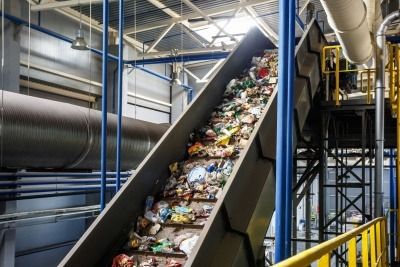
AIM explained to Resource that sorting at Materials Recycling Facilities (MRFs) is currently done through near-infrared (NIR) sorting technologies, and to overcome the limitations of NIR (e.g. sorting of food vs. non-food packaging) it has explored the option of digital watermark technology.
HolyGrail 2.0, AIM says, looks into coding the surface of packaging for consumer goods with imperceptible codes (digital watermarks), which are the size of a postage stamp. The codes are then applied in the packaging’s label artwork or 'embossed in the mould’, carrying a wide range of information including the package's manufacturer, Stock-Keeping Unit (SKU), the type of plastics used and composition, and food vs. non-food usage.
The initiative's focus is on how these digital watermarks can be used for ‘improved sorting processes of post-consumer packaging waste’. AIM says that ‘once the coded packaging enters a waste sorting facility, the digital watermark can be detected and decoded by a high resolution camera on the sorting line, which then – based on the transferred attributes – is able to sort the packaging in corresponding streams (e.g. food vs. non-food)’.
This could see a more accurate sorting stream and therefore higher level quality of recyclates, benefiting the complete packaging value chain with ‘a robust, cost-effective, and easily scalable system’.
Benefiting the value chain
AIM claims that as well as encoding a ‘digital recycling passport’, digital watermarks can also be used in other areas. For example, consumer engagement – potentially helping people sort recycling at home with information on an app, supply chain visibility and retail operations.
Within HolyGrail 2.0, however, AIM remains focused on ‘improving the sorting of packaging waste – achieving better and more accurate sorting streams and consequently, higher-quality recyclates will benefit the complete packaging value chain’.
According to INEOS, joining the initiative reinforces its own commitment to creating a circular economy ‘where all plastics can be properly recycled and reused in high-quality products, thereby reducing the carbon footprint of plastic products and packaging’.
Rob Ingram, CEO, INEOS Olefins and Polymers North, said: “Partnering with HolyGrail 2.0 demonstrates our commitment to taking action across the value chain, to create a more sustainable future.
“It fits perfectly with the INEOS goal to increase recycling rates and the use of recycled materials back into everyday products. This is an exciting next step on our path to full packaging circularity.
“Plastics are essential to our everyday lives. They keep our food fresh and safe to eat, and help us produce other day-to-day items, like our phones and our televisions. But we recognise and share people’s concerns – working together we can make the plastic economy more circular, and help to reduce plastic waste.”


Get our weekly digest
resource.co article ai

How will the government and DMOs address the challenges of including glass in DRS while ensuring a level playing field across the UK?
There's no easy solution to include glass in the DRS while maintaining a level playing field. Potential approaches include a phased introduction of glass, potentially with higher deposits to reflect its logistical challenges. The government and DMOs could incentivise innovation in glass packaging design and subsidise dedicated return points for glass-handling. Exemptions for smaller businesses unable to handle glass might also be necessary. Any successful solution will likely blend several approaches. It must address the differing priorities of devolved administrations, balance environmental benefits with logistical and cost implications, and be supported by robust consumer education campaigns emphasizing the importance of glass recycling.