

Students at New College Lanarkshire recycled 20,177 cans and plastic bottles during a five-week trial after a 20p financial incentive was introduced, representing an 80-fold increase compared to the previous year.
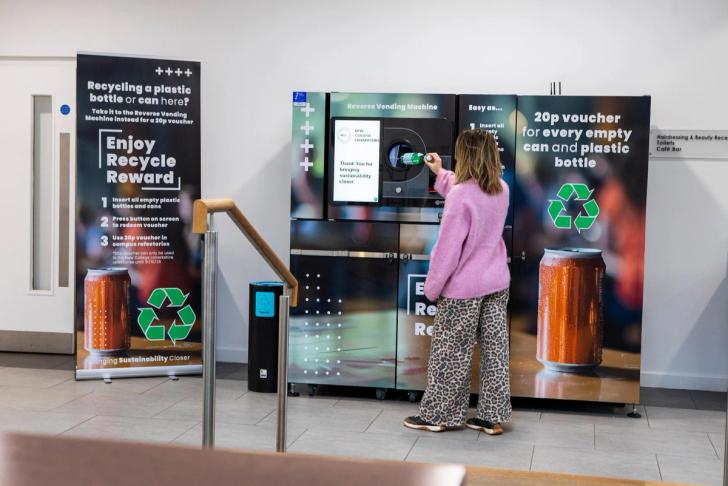
Students at New College Lanarkshire recycled 20,177 cans and plastic bottles during a five-week trial period after a 20p financial incentive was introduced for using reverse vending machines (RVMs) on campus.
The trial, a partnership between environmental charity Keep Scotland Beautiful, New College Lanarkshire and Coca-Cola Europacific Partners (CCEP), saw RVMs used 80 times more than during the same period last year. In the same five-week period in 2024, just 255 bottles and cans were recycled through the machines.
Students across the Motherwell, Coatbridge and Cumbernauld campuses recycled 11,293 cans and 8,884 plastic bottles between early September and early October, with credits redeemable at college canteens. The trial demonstrated an 80 per cent redemption rate for the 20p vouchers students received.
However, usage dropped sharply once the incentive ended, with just 346 containers recycled the following week, a 91 per cent decrease on the trial's weekly average of approximately 4,035 containers.
Barry Fisher, Chief Executive of Keep Scotland Beautiful, said: "As expected a small incentive drove a huge increase in the use of these Reverse Vending Machines during this trial period. Thanks to our consistent messaging across the college campuses the students were well informed of the machines and the incentive, and with two years until we see a UK-wide Deposit Return Scheme it's vital that the public are aware of its introduction to ensure it is a success from the start."
Previous trials
The initiative builds on findings from a previous campaign between Keep Scotland Beautiful, CCEP and the University of Strathclyde, which tested various interventions and messaging to understand students' recycling motivations.
The University of Strathclyde campaign found that 50 per cent of students felt an incentive would encourage them to recycle more, a finding reflected in the New College Lanarkshire results.
Jo Padwick, Senior Sustainability Manager at Coca-Cola Europacific Partners GB, said: "It's hugely encouraging to see such positive results from our trial. The findings clearly show that even a small incentive can be a powerful motivator to recycle and engage with a Deposit Return Scheme."
Padwick added: "These studies are allowing us to see first-hand how people interact with a DRS in reality and build a picture of what recycling behaviour will look like ahead of its eventual rollout across the UK in 2027."
Implications for UK deposit return scheme
Parliament approved legislation in January to establish a deposit return scheme for drinks containers in England and Northern Ireland, set to launch in October 2027. Scotland plans to implement a compatible scheme simultaneously.
The scheme will require consumers to pay a deposit when purchasing drinks in plastic and metal containers, which can be reclaimed when returned through designated collection points. The UK Government aims to collect 70 per cent of containers by 2028, increasing to 90 per cent by 2030.
Professor Christopher Moore, Principal and Chief Executive at New College Lanarkshire, said: "We were delighted to be a partner on this important project. The success of this trial reveals just what can be accomplished when the incentives are right. When young people are given the right support they can make huge and positive changes to their environment."
The UK Government estimates that 36,750 reverse vending machines will be required for full UK implementation of the deposit return scheme.


Get our weekly digest
resource.co article ai

How will the government and DMOs address the challenges of including glass in DRS while ensuring a level playing field across the UK?
There's no easy solution to include glass in the DRS while maintaining a level playing field. Potential approaches include a phased introduction of glass, potentially with higher deposits to reflect its logistical challenges. The government and DMOs could incentivise innovation in glass packaging design and subsidise dedicated return points for glass-handling. Exemptions for smaller businesses unable to handle glass might also be necessary. Any successful solution will likely blend several approaches. It must address the differing priorities of devolved administrations, balance environmental benefits with logistical and cost implications, and be supported by robust consumer education campaigns emphasizing the importance of glass recycling.