

The Scan|Recycle|Reward pilot collected data from residents of the mid-Wales town who used smartphones to claim 10p on eligible containers to test the efficacy of a digital deposit return scheme
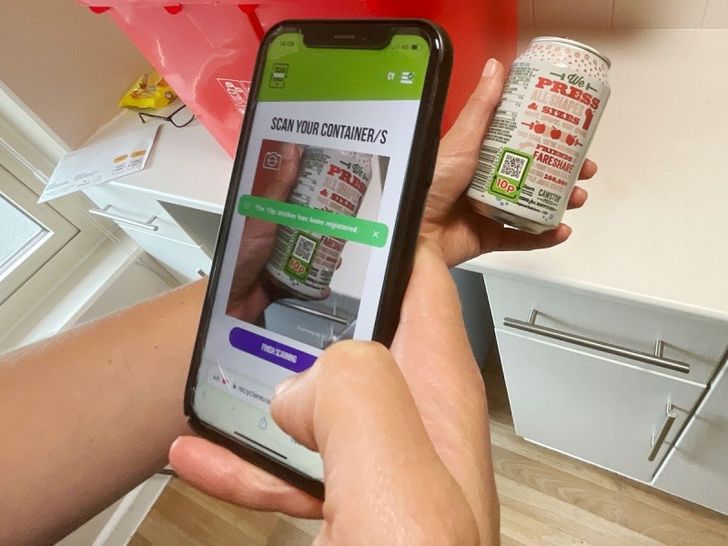
Results published today (18 April), indicate a good level of public support for a digital deposit return scheme (DDRS) based on a trial that ran between July and November 2023. Despite being an ‘early stage trial’, introducing a new scheme to residents in Brecon, 56 per cent of people said that they ‘would recommend the scheme in future’.
The trial - which did not involve an actual deposit priced on the container - was conducted by the DDRS Alliance in collaboration with the Welsh Government, Powys County Council, WRAP’s Collaborative Change Programme, and local retailers aimed to explore how the public would respond to the mechanics of a DDRS.
Conventional deposit return schemes (DRS) involve a deposit paid at the purchase of drinks containers, refunded upon their return for recycling. The DDRS trial in Brecon tested the use of additional digital technology, principally the use of smartphones and an app, which participants could use to claim a 10p reward for each container returned.
The trial covered a range of container types including PET bottles, aluminium cans, cartons, and glass bottles, each varying in size from 50 ml to 2 litres. Excluded from the trial were multipacks, alcoholic beverages, and multi-serve chilled products.
Each eligible drink container was equipped with a QR code sticker before it was placed on shop shelves for sale, which enabled every scanned item to be uniquely identified. This prevents the potential for fraud by ensuring that once a container was scanned and the reward redeemed, the QR code associated with that container could not be used again.
Participants used smartphones or similar devices to scan the QR codes on their drink containers whenever they decided to return them. This scanning process enabled participants to interact directly with the DDRS database, where they could register their return and claim their reward. Depending on the chosen return method, the reward was either directly credited to the participant’s account or issued as a voucher.
Reporting the findings, WRAP says the scheme recorded high community engagement, with 18,794 rewards claimed, which equates to more than four claims per household during the trial.
Cabinet Secretary for Climate Change, Huw Irranca-Davies, commented on the community’s involvement: “I’d like to thank the people of Brecon for taking part in the Digital Deposit Return Scheme trial – their willingness to get involved will help develop our plans for the DRS across Wales. This trial will support our ongoing work into DDRS and help build on our already world-class recycling rates. Our aim is to move to a more circular economy where resources are reused and recycled rather than being wasted.”
The Digital Deposit Return Scheme (DDRS) trial in Brecon tested several return methods, each designed to cater to different user preferences and logistical considerations:
- Kerbside: Placing scanned containers in the weekly municipal recycling service accounted for 58 per cent of all returns, reflecting its convenience and accessibility, the advantage being that it did not require any additional travel or effort beyond their normal recycling practices.
- Automated Return Point (ARP): The trial used simplified versions of traditional reverse vending machines, sited at strategic locations including a Morrisons supermarket and Brecon Leisure Centre, to maximise footfall. Unlike typical reverse vending machines, ARPs lacked sophisticated mechanisms like shape recognition or internal conveyors. Apparently costing 25 per cent the price of a typical reverse vending machine, the ARPs are equipped with front-mounted scanners, enabling users to manually scan and deposit their returns, which included partially crushed containers. This made them accessible with or without a smartphone, thereby accommodating a wider range of participants. In total, the ARPs accounted for 18 per cent of the returns during the trial.
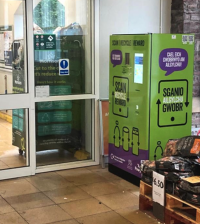
- Community Bins: Designed as an on-the-go return option, community bins were placed in easily accessible public areas, requiring a smartphone to scan the container and credit the reward to an online account. This method aimed to cater to the needs of mobile users and those who consume beverages on-the-go proved the least popular channel, accounting for three per cent of returns.
- Over the Counter Return (OTC): This method allowed participants to return their containers directly at participating shops, where the rewards were redeemed as cash without the necessity of a smartphone.
Matt Perry, Powys County Council’s Chief Officer, commented: “The residents, visitors, and retailers of Brecon thoroughly embraced their involvement in this innovative trial, and it was encouraging to witness everyone’s enthusiasm and willingness to give the digital technology a go. The results show for themselves how a digital version of the traditional return deposit schemes could easily be incorporated into the already established weekly kerbside collections services offered by most local authorities making life easier for citizens to return containers whilst also keeping our carbon footprint to a minimum.”
The DDRS Alliance, which incorporates members from five European countries, developed the technology solution for the Brecon trial. Duncan Midwood, Co-founder & Director of DDRS Alliance, said: “This trial was incredibly complex, involving 24 retailers and over 50 suppliers and partners. Despite its complexity, it worked flawlessly and has delivered some great insight and, more importantly, showed that the British public values a solution for increasing recycling and reducing litter that fits in with their varied and busy lives.”
The trial also demonstrated the system’s reliability with a 97.6 per cent capture compliance rate for containers returned. Moreover, the quality of the material collected was high across all return routes, ensuring the recycling process was effective.
Insights from the Brecon DDRS trial will be considered by the Welsh Government in advance of forthcoming plans to introduce a countrywide deposit return scheme. Claire Shrewsberry, Director of Insights & Innovation at WRAP, emphasised the value of the findings from Brecon: "This trial has been hugely important to better understand the complexities of operating a successful DDRS scheme in Wales. It’s clear that the people involved have completely embraced the options. WRAP looks forward to helping Welsh Government introduce a DRS system that works successfully across the whole country and builds on its impressive recycling performance."


Get our weekly digest
resource.co article ai

How will the government and DMOs address the challenges of including glass in DRS while ensuring a level playing field across the UK?
There's no easy solution to include glass in the DRS while maintaining a level playing field. Potential approaches include a phased introduction of glass, potentially with higher deposits to reflect its logistical challenges. The government and DMOs could incentivise innovation in glass packaging design and subsidise dedicated return points for glass-handling. Exemptions for smaller businesses unable to handle glass might also be necessary. Any successful solution will likely blend several approaches. It must address the differing priorities of devolved administrations, balance environmental benefits with logistical and cost implications, and be supported by robust consumer education campaigns emphasizing the importance of glass recycling.