

Pressure group ‘Say No to an Incinerator at Barr/Kiloch’ has welcomed the Scottish Government’s recent independent review of the role of incineration in the country’s waste hierarchy.
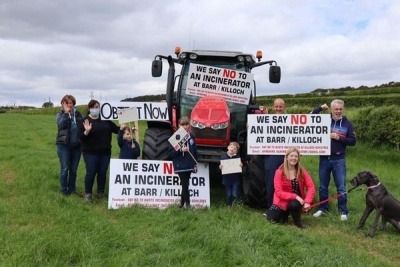
The report, authored by Dr Colin Church, found that incineration’s current place in the hierarchy as ‘preferable to other forms of residual waste treatment, but less desirable than reducing and recycling waste’ to be correct.
The review went on to suggest that Scotland should ‘limit the granting of further planning permissions for incineration infrastructure’, with an ‘indicative cap’ to be developed for Scotland’s residual waste treatment needs. This should decline ‘as Scotland transitions towards a fully circular economy.’
On 17 May, a stakeholder meeting with Dr Colin Church was held to discuss the results of the review. Say No asked whether the report’s recommendations offered clarification on the group’s call to stop the incinerator at the Killoch site by Barr Environmental.
The group referred to recommendation four, which says that planning permission for incineration infrastructure within the scope of the review can be granted – conditional on the construction being balanced by an equal or greater closure of capacity.
Church responded: “The point of recommendation four is that over time facilities close, operational facilities close, and these closing facilities could be replaced. It is not to replace something that is not in operation.
“So the effect of the recommendations, if the Scottish government were to accept them, would be that the planning application for the Energy from Waste (EfW) moving-grate incinerator at Killoch should not be granted.”
In a statement, Say No said: “This gives us full clarification that the Killoch incinerator was looked at in the review as a new application, and was not to replace the capacity of the previously granted gasification plant at Killoch, as it has not been built or in operation.”
Say No campaigner Annie Hood added: "Dr Church's words were music to my ears. What a relief to be certain that, after considering all the evidence, Dr Church came out strongly and clearly against Barr's proposal for an incinerator in Killoch.
“I hope the Scottish government is listening, and that confirmation of the refusal is made public in order to reassure local residents that this terrible threat has now passed.”


Get our weekly digest
resource.co article ai

How will the government and DMOs address the challenges of including glass in DRS while ensuring a level playing field across the UK?
There's no easy solution to include glass in the DRS while maintaining a level playing field. Potential approaches include a phased introduction of glass, potentially with higher deposits to reflect its logistical challenges. The government and DMOs could incentivise innovation in glass packaging design and subsidise dedicated return points for glass-handling. Exemptions for smaller businesses unable to handle glass might also be necessary. Any successful solution will likely blend several approaches. It must address the differing priorities of devolved administrations, balance environmental benefits with logistical and cost implications, and be supported by robust consumer education campaigns emphasizing the importance of glass recycling.