

Viridor and Clyde Valley Waste report back on first year of rMRF
Clyde Valley Waste has processed 178,000 tonnes of waste through Viridor’s Materials Recycling Facility at Bargeddie, North Lanarkshire.
Viridor’s residual Materials Recycling Facility (rMRF) was designed to work with five Scottish councils, on a 25-year contract, led by North Lanarkshire Council, along with East Renfrewshire, East Dunbartonshire, Renfrewshire and North Ayrshire councils.
The contract started in January 2020 and the plant has extracted over 6,000 tonnes of recyclate over the year.
Black bag waste is processed at the Bargeddie Hub and, after the recyclate is extracted for further processing, the remaining non-recyclable waste is sent for energy recovery.
Andrew McPherson, Head of Regulatory Services and Waste Solutions at North Lanarkshire Council, said: “Viridor’s investment in the latest technology at their Bargeddie and Dunbar facilities means we can create energy from the household waste that would otherwise go to landfill.
“Our partnership is making a significant contribution to meeting diversion from landfill targets as well as reducing our carbon footprint.”
Steven Don, Head of Local Authority Contracts, Scotland, said: “Not only is it important to find a meaningful way to attach a value to waste which cannot be recycled, it is crucial for Scotland to have landfill-diversion contracts in place ahead of Scotland’s 2025 landfill ban.
“The partnership made history when the councils joined forces, the first to do so in Scotland, and it continues to collaborate to responsibly manage the regions’ waste so this material can be treated as a resource and not rubbish.”
Hambleton brings in more recycling vehicles part-powered by electricity
Hambleton District Council has grown its refuse and recycling collection fleet with vehicles part-powered by electricity, as a result of local population growth, increased recycling quantities and extensive new residential developments.
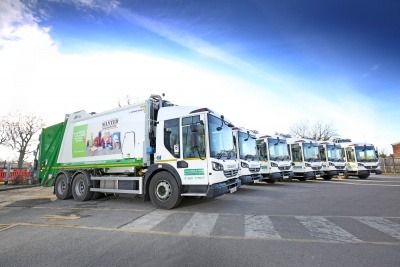
In February, the council took delivery of six new 26-tonne Dennis Eagle Twinpack refuse trucks. These vehicles are designed with electric triple bin lifts, which use less diesel than hydraulic lifts.
Hambleton District Council already runs four electric vehicles, comprising two cars and two Nissan eNV200 electric vans.
Cllr Stephen Watson, Cabinet spokesperson for Hambleton District Council, said: “Unfortunately, we cannot move to all electric vehicles as our rounds are too long and currently the technology would not allow them to complete a round without needing recharging.
“But we are looking at all ways to reduce emissions and using electric vehicles where it is possible.”
Sue Seddon, Technical Support Manager at Hambleton District Council, said: “We have invested in an additional vehicle to accommodate collections from a large number of new properties, which will ultimately create a new round.
“The sixth vehicle will be supporting the rest of the fleet with recycling, garden waste and household refuse collections until the new properties come online.”
All the vehicles have been provided by the council’s vehicle partner Specialist Fleet Services Ltd (SFS) as part of a ten year contract hire agreement awarded in 2015.
Biffa boosts plastic recycling capacity in Sunderland by £13 million
Biffa has invested £13 million into high-density polyethylene (HDPE) plastic recycling in its Washington facility in Sunderland.
With this increase, Biffa has the capacity to recycle an additional 14,000 tonnes HDPE a year, growing its total annual capacity to 39,000 tonnes.
This will create 50 new jobs in the local Sunderland area, adding to 115 employees in Washington and 140 employees in the Redcar facility.
This is Biffa’s latest investment in their strategic commitment to building a circular economy. The company plans to quadruple its plastic recycling capacity by 2030.
The company’s capacity expansion comes in time for the new plastic packaging tax, due to take effect from April 2022. This tax will apply to plastic packaging that does not contain at least 30 per cent recycled plastic.
An estimated extra 36,000 tonnes of HDPE recycling will be needed to meet the demand triggered by the legislation, and to benefit packaging producers that aim to avoid the new tax.
Chief operating officer for Biffa’s resources and energy division, Mick Davis, commented: “This investment in Washington is another example of Biffa on-shoring recycling capacity in our strategic journey to creating closed loop recycling in the UK.
“We look forward to being able to offer UK manufacturers more high-quality recycled plastics and help prevent the export of plastics for reprocessing.
“We have a strong and growing presence in the North East of England, a region which is playing a leading role in the UK’s green industrial revolution and we are delighted to be creating a further 50 new jobs as part of these plans.”
UKs largest eRCV fleet starts work in Manchester
Waste management company Biffa has announced that the country’s largest fleet of electric refuse vehicles (eRVC) will start work on the streets of Manchester today (March 8), through a partnership with Manchester City Council, which is investing £10 million.
27 brand-new zero emissions vehicles, designed to help reduce air pollution, will now collect household and municipal waste across the Manchester area.
The vehicles are designed to be quieter but just as powerful and cost efficient to run as diesel vehicles and are able to complete a full shift on one charge.
The roll out in Manchester follows two years of successful trials and sees Manchester City Council become one of the first local authorities to switch to eRVCs.
The Council has said they anticipate the move to eRVCs will help to progress its zero-carbon action plan that aims to halve emissions by 2025, which is part of a wider drive to make Manchester carbon free by 2038.
Councillor Rabnawaz Akbar, Executive Member for Neighbourhoods, said: “We’re proud that Manchester City Council, working with Biffa, has made the most significant investment of any council in emission-free refuse collection vehicles and that the waste and recycling service is playing its part in binning pollution.”
Biffa has reduced its Co2 emissions by 65% since 2002 and has said its investment in sustainable waste vehicle technology is contributing to reaching a target of a further 50% reduction by 2030.
Michael Topham, Chief Executive at Biffa, added: "We are delighted to be launching the UK’s largest ever fleet of electric refuse collection vehicles and supporting one of the UK’s top cities to become even greener.
"Biffa has a longstanding partnership with Manchester City Council, and we are committed to helping the city to halve its direct emissions by 2025.
"We are confident this is just the start and we will see many more electric vehicles in action across the country in coming years.”
Stericycle opens alternative treatment plant
Stericycle UK, provider of clinical waste and secure information destruction services, has announced the opening of an alternative treatment plant in Telford, Shropshire.
The plant will steam-treat clinical waste, including testing materials, sharps, hospital waste, and personal protective equipment (PPE) created by the COVID-19 pandemic.
The new Telford plant, which will be staffed by over 60 people, will use the waste as fuel for power generation and other industrial processes. The plant is expected to reduce the amount of treated clinical waste sent to landfill for disposal by up to an estimated 48 tonnes per day.
"The COVID-19 pandemic and immunisation drive are generating clinical waste across the U.K. health system," said Stericycle UK commercial director, James Cardwell-Moore.
"As a company focused on safeguarding the world around us, we continue to invest in modernising our facilities with the latest innovative technologies to support the NHS and other healthcare customers across the UK.
“Stericycle is proud to play an essential role in mitigating the spread of COVID-19 by removing potentially infectious clinical waste safely and disposing of it in an environmentally responsible and sustainable way."
Simon Clarke, managing director, Birmingham Hospitals Alliance (BHA) Shared Procurement Services, said: "The Trust has a strong partnership with Stericycle, and they have supported us through the COVID pandemic.
“We welcome the investment made in their new facility at Telford, which will create additional network capacity to benefit NHS customers."


Get our weekly digest
resource.co article ai

How will the government and DMOs address the challenges of including glass in DRS while ensuring a level playing field across the UK?
There's no easy solution to include glass in the DRS while maintaining a level playing field. Potential approaches include a phased introduction of glass, potentially with higher deposits to reflect its logistical challenges. The government and DMOs could incentivise innovation in glass packaging design and subsidise dedicated return points for glass-handling. Exemptions for smaller businesses unable to handle glass might also be necessary. Any successful solution will likely blend several approaches. It must address the differing priorities of devolved administrations, balance environmental benefits with logistical and cost implications, and be supported by robust consumer education campaigns emphasizing the importance of glass recycling.